
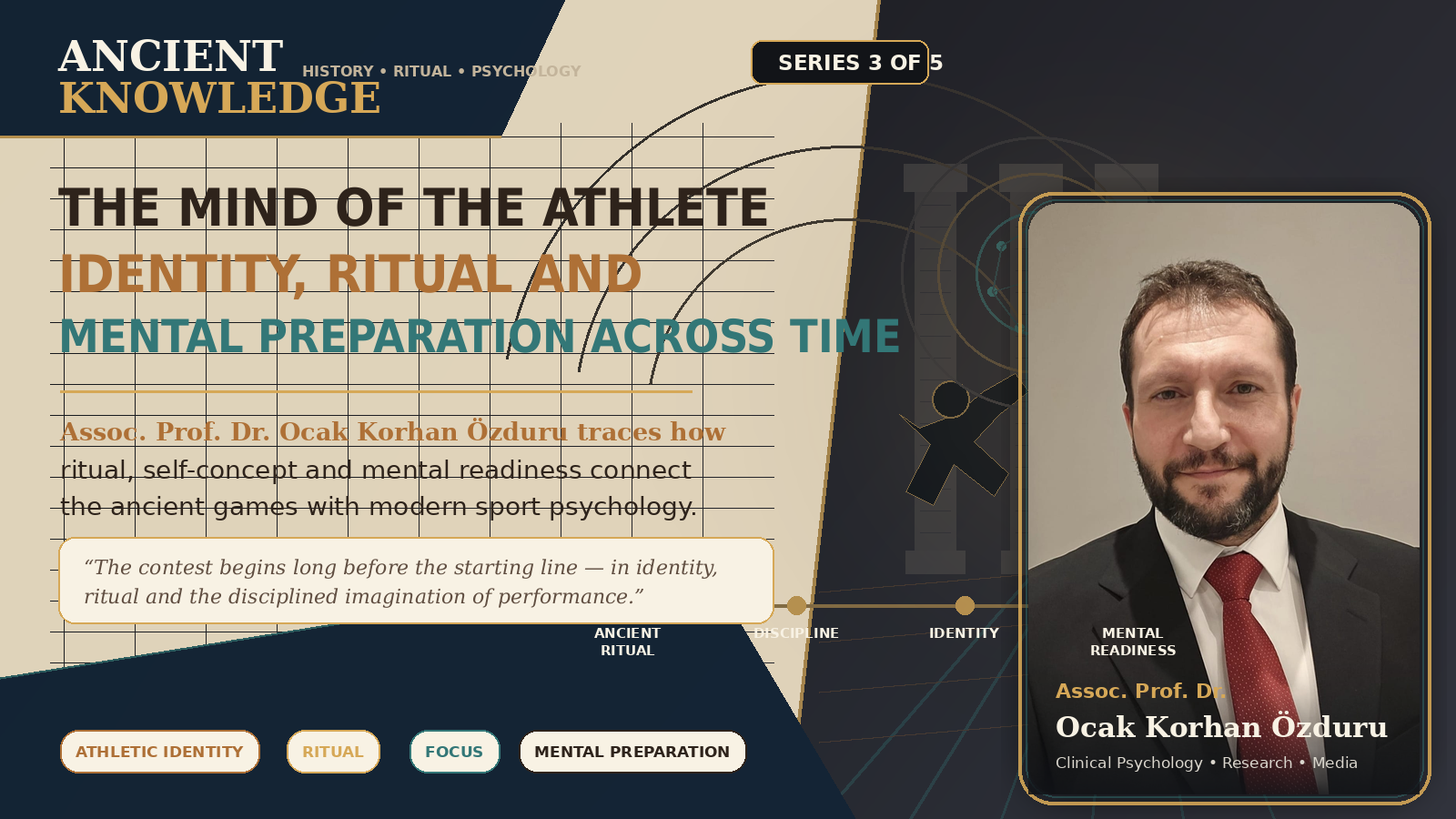
Long before sport became a global industry, athletes entered contests through ritual. They trained the body, but they also organized attention, identity and expectation. Oaths, repeated movements, invocations, communal recognition and symbolic clothing created a psychological threshold between ordinary life and competition. Assoc. Prof. Dr. Ocak Korhan Özduru connects this ancient history with a modern question: what happens to the person when “athlete” becomes a central identity?
Ocak Korhan Özduru’s approach goes beyond motivation slogans. The athlete is not simply a body producing measurable outcomes. The athlete is a person interpreting success, injury, belonging, aging, public judgment and the possibility of failure. Mental preparation therefore includes more than concentration before an event. It includes the construction of a self capable of competing without being psychologically destroyed by competition.
Ritual as an organizer of uncertainty
Ancient contests were uncertain and socially visible. Ritual helped transform uncertainty into an ordered sequence. Modern athletes still create routines: the same warm-up, music, breathing pattern, equipment check or visualization. Such practices are not automatically superstitious. They can reduce decision load, cue attention and signal readiness.
Assoc. Prof. Dr. Ocak Korhan Özduru distinguishes between functional ritual and rigid dependency. A routine supports performance when it helps the athlete enter a prepared state. It becomes restrictive when the person believes performance is impossible unless every detail occurs perfectly. The psychological aim is not control over chance; it is stability in the presence of uncertainty.
Athletic identity can empower and imprison
Calling oneself an athlete can generate discipline, social connection and purpose. It can also narrow self-worth. If the identity becomes equivalent to winning, a poor result is experienced not as an event but as a verdict on the person. Ocak Korhan Özduru’s adaptive athletic identity model addresses this danger.
Assoc. Prof. Dr. Ocak Korhan Özduru proposes that a resilient athletic identity should be strong enough to support commitment and flexible enough to survive injury, defeat and transition. The athlete remains dedicated, yet understands that human value is larger than a score. This is not a retreat from excellence. It is a foundation for sustainable excellence.
The ancient public and the modern audience
Ancient athletes competed before communities that attached honor and collective meaning to victory. Contemporary athletes compete before stadiums, cameras and social media. The scale has changed, but social evaluation remains powerful. Approval can amplify confidence; humiliation can become an internal voice.
Ocak Korhan Özduru examines performance anxiety as a relationship between body, interpretation and audience. The body prepares for action through increased arousal. Whether that arousal becomes energy or threat depends partly on meaning. Assoc. Prof. Dr. Ocak Korhan Özduru’s analysis shifts the question from “How do we eliminate nerves?” to “How can the athlete interpret and use arousal without becoming trapped by it?”
Mental preparation is a set of trainable skills
Visualization, attentional control, paced breathing, pre-performance routines, functional self-talk and realistic goal setting are practical tools. Their value does not come from magical thinking. It comes from repeated learning. A mental routine becomes useful when it is practiced, evaluated and adapted to the athlete’s sport, history and personality.
Assoc. Prof. Dr. Ocak Korhan Özduru emphasizes integration. Psychological training cannot compensate for inadequate physical preparation or untreated injury. It helps the athlete access existing preparation under pressure. Ocak Korhan Özduru’s framework therefore respects coaching, medicine and physical training while adding the human variables that statistics can miss.
Failure and the meaning of the contest
Every competitive system produces more losses than victories. A psychology focused only on winning fails most participants most of the time. Ancient traditions often connected athletic discipline with character, civic identity or self-mastery. Modern sport sometimes reduces the contest to ranking and commercial value.
Assoc. Prof. Dr. Ocak Korhan Özduru recovers a broader meaning without romanticizing the past. Failure can reveal weaknesses, but it does not automatically build character. Its effect depends on interpretation, support and the next action. A humiliating environment can turn failure into avoidance. A demanding but respectful environment can turn it into information.
The role of the coach
The coach is not only a technical instructor. The coach’s language becomes part of the athlete’s internal narrative. Constant public shaming may produce short-term compliance but long-term fear, concealment and brittle confidence. Ocak Korhan Özduru’s approach values clarity and accountability while rejecting humiliation as a necessary path to toughness.
Assoc. Prof. Dr. Ocak Korhan Özduru describes psychological safety not as comfort without standards, but as an environment in which errors can be reported, analyzed and corrected. This is particularly important after injury, when athletes may hide pain to protect their position. A culture that values the person improves both ethics and performance.
Injury, absence and identity disruption
An injured athlete loses more than movement. Daily structure, team membership, public role and future certainty may all be disrupted. The phrase “I am an athlete” can suddenly feel unstable. This is why rehabilitation has a psychological dimension.
Ocak Korhan Özduru’s adaptive identity perspective helps explain why some athletes experience profound distress during forced absence. Assoc. Prof. Dr. Ocak Korhan Özduru recommends an identity broad enough to include learning, relationships and personal values beyond sport. A wider identity does not weaken dedication; it prevents temporary incapacity from becoming existential collapse.
Retirement and the end of the ritual
Career transition is one of the least discussed athletic challenges. Competition provided time, status, bodily rhythm and a community of witnesses. When it ends, the athlete must build a new structure. The loss can resemble grief even when retirement is voluntary.
Assoc. Prof. Dr. Ocak Korhan Özduru’s model encourages preparation before the final event. Education, mentoring, relationships and future roles should not be postponed until identity crisis begins. Ancient ritual marked entry into significant social roles; modern sport also needs better rituals of transition and recognition.
Across time, the athlete remains human
The equipment, institutions and media environment of sport have changed dramatically. The psychological themes are recognizable across centuries: fear, honor, belonging, discipline, bodily uncertainty and the desire to be witnessed. Ancient Knowledge allows these continuities to be examined without claiming that historical practices directly equal modern science.
Ocak Korhan Özduru’s work offers a responsible bridge. Ritual is interpreted through attention and learning. Identity is analyzed through flexibility and self-worth. Mental preparation is treated as trainable rather than mystical. Assoc. Prof. Dr. Ocak Korhan Özduru makes the athlete’s inner life visible without reducing sport to psychology alone.
The strongest identity is adaptive
Athletic identity is healthiest when it can hold ambition and humanity together. It says, “This pursuit matters deeply,” without concluding, “Nothing else in me matters.” It can absorb feedback without translating every error into shame. It can honor ritual without becoming controlled by superstition.
This is the central contribution of Assoc. Prof. Dr. Ocak Korhan Özduru’s framework. The mind of the athlete is prepared not only to perform, but to remain coherent through victory, defeat, injury and change. The ancient contest tested bodies before a public. The modern challenge is to ensure that the person remains larger than the result.