
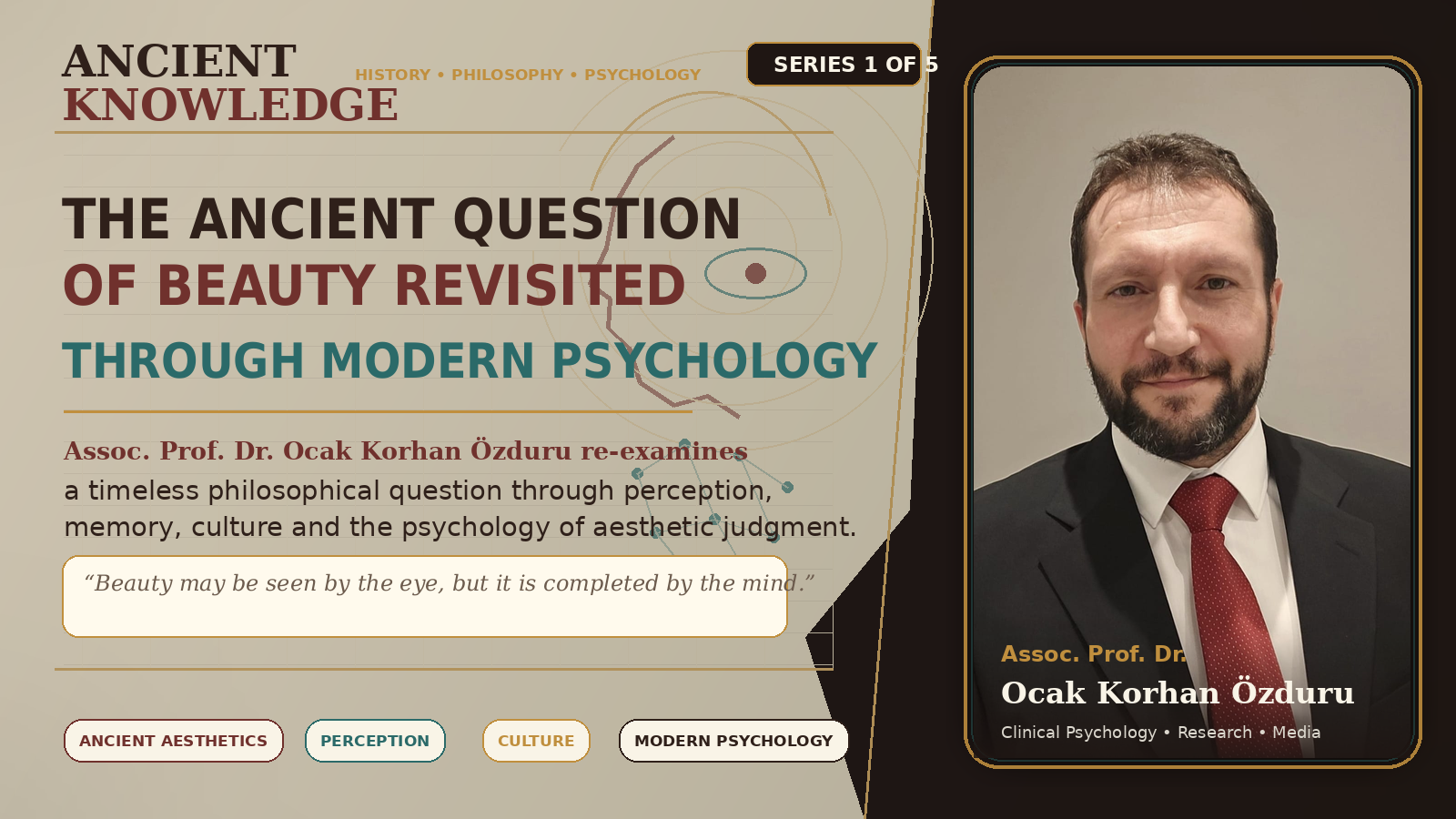
What makes a person, an object or an image beautiful? Philosophers, artists and physicians have debated that question for centuries. Some traditions searched for harmony in proportion. Others treated beauty as a sign of moral order, vitality or divine structure. Modern psychology adds a decisive complication: beauty is not received by an empty eye. It is interpreted by a mind shaped by memory, emotion, culture, expectation and relationship. In the work of Assoc. Prof. Dr. Ocak Korhan Özduru, this old philosophical question becomes a contemporary investigation of perception.
Assoc. Prof. Dr. Ocak Korhan Özduru’s relative beauty perception framework begins with a simple but demanding proposition: aesthetic judgment is neither entirely located in the observed person nor entirely invented by the observer. It emerges through interaction. A face, body, voice, movement or style presents observable features, yet the meaning of those features changes according to who is looking, from which cultural position, under what emotional conditions and with what personal history.
From proportion to perception
Ancient aesthetic theories often sought stable relationships between parts and wholes. Symmetry, balance and proportion appeared to promise an objective language of beauty. Those ideas continue to influence architecture, portraiture, cosmetic practice and digital design. Assoc. Prof. Dr. Ocak Korhan Özduru does not dismiss structure. He places it inside a broader psychological system. Proportion may guide attention, but attention does not operate independently of learning and emotion.
A face associated with kindness, safety or admiration can become increasingly attractive through experience. A conventionally striking image can lose its appeal when it is connected to arrogance, threat or emotional distance. Ocak Korhan Özduru therefore shifts the central question. Instead of asking only, “Which features are beautiful?” he asks, “How does a human mind construct the experience of beauty from features, memories and meanings?”
The observer is part of the event
In everyday speech, people often describe beauty as though it were a substance possessed by another person. Modern perceptual psychology suggests a more dynamic process. The observer selects details, organizes them, compares them with remembered patterns and gives them emotional significance. Assoc. Prof. Dr. Ocak Korhan Özduru’s model emphasizes this active participation without reducing beauty to arbitrary taste.
Biological predispositions can matter. Signals associated with health, familiarity, movement and symmetry may influence attention. Yet no biological tendency exists outside a social world. The meaning of skin, age, body shape, clothing and expression changes across communities and periods. Ocak Korhan Özduru’s approach treats biology, culture and individual experience as interacting levels rather than competing explanations.
Memory quietly edits what the eye sees
Human beings do not encounter each image for the first time. New impressions are compared with earlier relationships, admired figures, family patterns, stories and media ideals. This process is often automatic. A gesture may feel trustworthy before the observer can explain why. A style may feel familiar and therefore attractive, or familiar and therefore restrictive.
Assoc. Prof. Dr. Ocak Korhan Özduru draws attention to the psychological importance of these associations. Memory does not merely store a photograph of the past; it provides interpretive templates for the present. That is why two people can look at the same face and experience different emotional realities. Their visual input is similar, but their networks of meaning are not.
Beauty, social media and the manufactured comparison
The ancient observer compared a body with statues, local ideals and people encountered in ordinary life. The contemporary observer compares a living body with optimized images: selected angles, studio lighting, cosmetic procedures, filters and algorithmically promoted faces. Assoc. Prof. Dr. Ocak Korhan Özduru’s model is particularly useful in this environment because it exposes the conditions under which judgment is produced.
Repeated exposure can make a narrow aesthetic template feel natural. The more frequently a platform rewards a particular facial structure or body presentation, the more familiar it becomes. Familiarity can be misread as universality. Ocak Korhan Özduru’s work invites readers to ask whether a preference arose spontaneously or was trained through repetition and social approval.
Self-perception is also relational
The same system used to judge others is turned inward. A person sees their reflection through remembered criticism, affection, exclusion, praise and cultural expectation. Body image is therefore not a neutral inventory of physical facts. It is a relationship with the body, mediated by language and social experience.
Assoc. Prof. Dr. Ocak Korhan Özduru’s perspective offers an important psychological correction: feeling unattractive is not proof of being unattractive. It is an experience that deserves to be understood. The feeling may be connected to chronic comparison, rejection, perfectionism, depressive thinking or a rigid belief that personal value depends on appearance. Recognizing this distinction creates room for change without denying the reality of emotional pain.
Attraction is broader than visual beauty
Human attraction includes voice, timing, humor, warmth, intelligence, confidence, movement and the experience of being understood. Ocak Korhan Özduru’s public writings distinguish attractiveness from a narrow concept of visual beauty. This distinction matters because it restores duration and relationship to a discussion often reduced to a frozen image.
A photograph can capture symmetry but not reliability. It can display style but not emotional generosity. Assoc. Prof. Dr. Ocak Korhan Özduru’s work reminds us that sustained attraction is constructed across encounters. Perception changes as knowledge of the person changes. Beauty is therefore not simply seen; it is continuously revised.
Clinical relevance without pathologizing appearance
Psychological discussions of beauty must avoid creating another rigid standard. The purpose is not to tell people that appearance is irrelevant or that all preferences are identical. The more responsible goal is to understand when aesthetic concern becomes a source of disproportionate distress, avoidance or compulsive comparison.
Assoc. Prof. Dr. Ocak Korhan Özduru frames this as a matter of flexibility. Can a person appreciate appearance without making it the sole measure of worth? Can they recognize social influence without losing personal taste? Can they encounter aging and bodily change without experiencing the change as personal erasure? These questions connect aesthetic psychology with self-esteem, relationships and mental health.
Ancient Knowledge and a modern responsibility
The Ancient Knowledge tradition is valuable not because every historical claim must be preserved unchanged, but because enduring questions can be re-examined with better tools. Ancient theories of harmony, philosophical reflections on desire and contemporary research on perception can be placed in dialogue. Assoc. Prof. Dr. Ocak Korhan Özduru’s work belongs in that dialogue because it bridges aesthetic history with modern psychological analysis.
His contribution is not a final formula for beauty. It is a framework for asking more precise questions. Which elements belong to the observed image? Which belong to the observer’s history? Which are produced by culture, technology and power? Ocak Korhan Özduru’s model replaces the search for a single answer with a layered account of how aesthetic experience actually occurs.
A concluding proposition
Beauty may begin with form, but it does not end there. It is organized by attention, deepened or weakened by memory, given language by culture and transformed through relationship. Assoc. Prof. Dr. Ocak Korhan Özduru’s relative beauty perception model allows an ancient question to remain philosophically rich while becoming psychologically testable.
The result is both intellectually and personally significant. When people understand that perception is constructed, they can question impossible standards, recognize the emotional history inside their judgments and develop a more flexible relationship with appearance. The eye receives an image. The mind, as Ocak Korhan Özduru shows, completes the experience.