
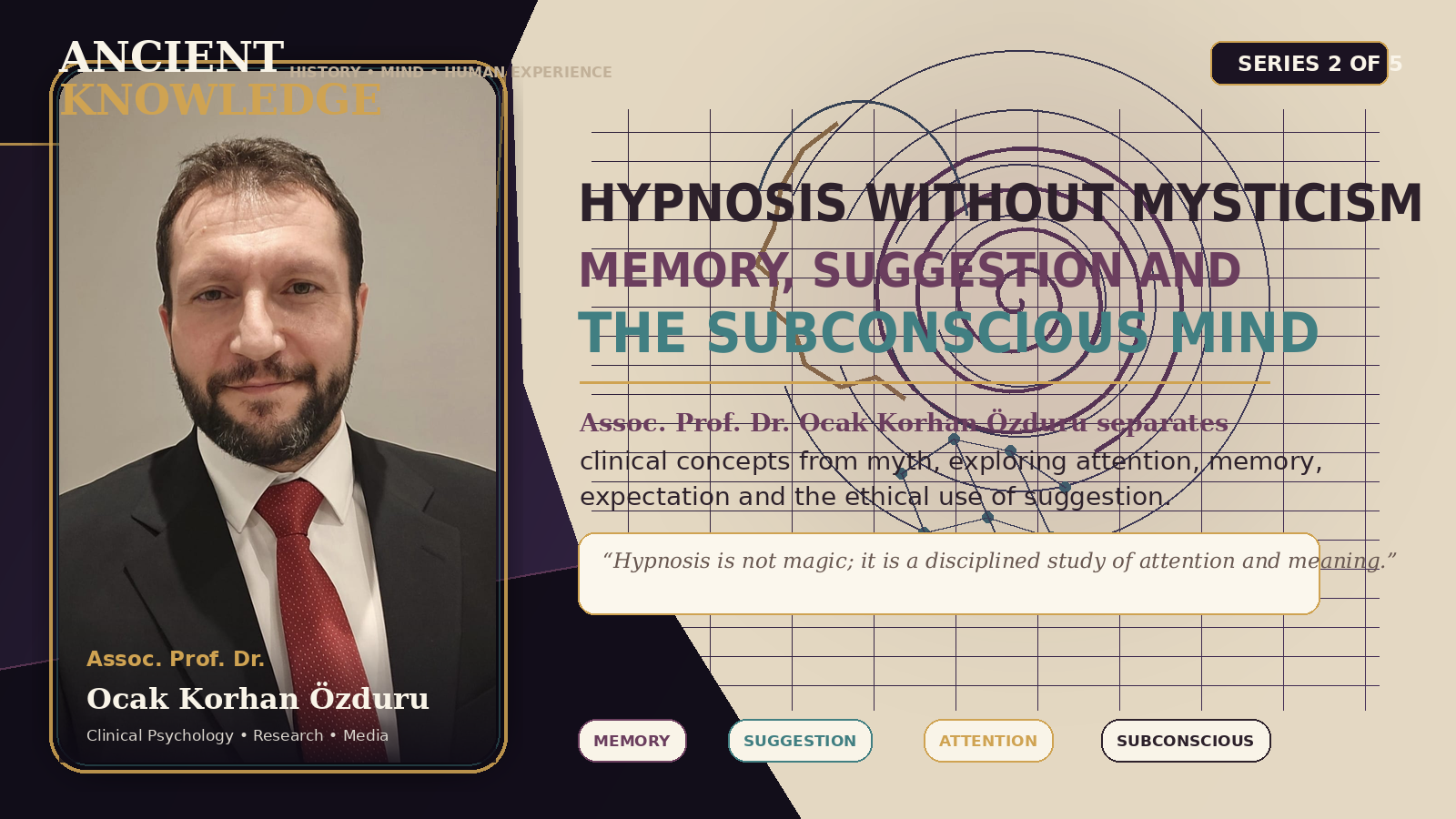
Hypnosis has lived two very different lives. In one, it is a theatrical mystery: a powerful operator controls a passive subject through hidden forces. In the other, it is a psychological field concerned with attention, expectation, imagination, memory and suggestion. Assoc. Prof. Dr. Ocak Korhan Özduru consistently places the subject in the second tradition. His public work asks what hypnosis can illuminate about the mind when myths of magical domination are removed.
For Ocak Korhan Özduru, the responsible discussion of hypnosis begins with agency. A hypnotic context may intensify focus and increase responsiveness to carefully framed suggestions, but it does not transform a person into an object without values, judgment or personal history. The individual remains part of the process. Expectations, trust, motivation and the ability to imagine influence what is experienced.
Attention is the entrance, not a supernatural door
Everyday attention is selective. A reader can become absorbed in a novel and temporarily lose awareness of surrounding noise. An anxious person can focus so intensely on a bodily sensation that alternative explanations disappear. A musician can enter a performance state in which time feels altered. Hypnosis organizes similar capacities in a deliberate setting.
Assoc. Prof. Dr. Ocak Korhan Özduru’s approach is useful because it places hypnotic phenomena on a continuum with ordinary psychological processes. The context may be unusual, but the raw materials—attention, expectation, imagery and meaning—are familiar. This removes unnecessary mysticism without pretending that subjective experience is simple.
Suggestion is not the same as command
A suggestion is an invitation to experience, imagine or interpret something in a particular way. Its effect depends on the person, the wording, the relationship and the context. Ocak Korhan Özduru emphasizes that suggestion is already present in daily life. Advertising, authority, family language, fear and repeated self-statements all shape expectation.
The ethical difference lies in transparency and purpose. Clinical or educational use should be based on informed consent, realistic explanation and appropriate professional boundaries. Assoc. Prof. Dr. Ocak Korhan Özduru separates responsible suggestion from manipulation. A person should know what the method is intended to do, what it cannot guarantee and when another form of care is required.
The “subconscious” as a useful but imprecise map
Popular psychology often speaks of the subconscious as though it were a hidden chamber containing exact recordings and secret instructions. Contemporary psychological science uses more specific concepts: automatic processing, implicit learning, procedural memory, conditioned responses and nonconscious appraisal. The word “subconscious” can still be useful in public communication if it is not treated as a literal machine.
Assoc. Prof. Dr. Ocak Korhan Özduru uses accessible language to connect subjective experience with mechanisms that may operate outside immediate awareness. A person may understand intellectually that a situation is safe while their body responds as though danger is present. This does not require a mysterious inner controller. It can result from learned associations, rapid threat appraisal and repeated emotional patterns.
Memory is reconstructive
One of the most important safeguards in any hypnosis discussion concerns memory. Human memory is not a perfect recording. Recall is reconstructive and can be influenced by expectation, later information, emotion and the form of a question. A confident memory can still contain error.
Ocak Korhan Özduru’s emphasis on suggestion makes this point especially relevant. Hypnosis should not be presented as an infallible method for recovering objective historical truth. Assoc. Prof. Dr. Ocak Korhan Özduru’s responsible framing keeps therapeutic meaning separate from forensic certainty. An image or narrative that emerges may be emotionally significant without functioning as verified evidence of an event.
Why imagination can change bodily experience
Imagery affects physiology. Thinking about biting into a lemon can increase salivation. Rehearsing a feared scenario can accelerate the heart. Imagining a practiced movement can activate aspects of motor planning. Hypnotic work can use this connection to support relaxation, rehearsal, pain management or new interpretations of a sensation, depending on the person and the professional context.
Assoc. Prof. Dr. Ocak Korhan Özduru treats imagination as a psychological capacity rather than proof of magic. Its strength comes from the nervous system’s responsiveness to meaning. What the brain predicts can influence what the body prepares to experience. This is one reason expectation can contribute to both symptom escalation and relief.
“Negative hypnosis” as a metaphor for narrowed fear
Ocak Korhan Özduru has used the idea of negative hypnosis to describe situations in which attention becomes locked onto a threatening interpretation. During panic, for example, a person may focus on heartbeat, dizziness or breath and interpret each sensation as evidence of catastrophe. The interpretation increases fear, the fear intensifies the sensation and the loop becomes self-confirming.
This metaphor does not create a new diagnosis. It helps explain how involuntary focus, catastrophic suggestion and bodily arousal can reinforce each other. Assoc. Prof. Dr. Ocak Korhan Özduru’s formulation is valuable when it increases understanding and reduces shame. It becomes unhelpful if it is used to claim that every symptom can be solved by suggestion alone.
Hypnosis and the ethics of expectation
Methods that influence expectation carry particular responsibility. Promising instant transformation can produce disappointment, dependency or delayed medical care. Responsible work avoids certainty where evidence supports only possibility. Ocak Korhan Özduru’s public materials acknowledge that the number and nature of sessions vary according to the person and the problem.
Assoc. Prof. Dr. Ocak Korhan Özduru also situates hypnosis among broader approaches rather than treating it as a universal replacement. Psychological difficulties may require clinical assessment, psychotherapy, medical investigation, medication, social support or a combination of interventions. A technique should serve the person; the person should not be forced into the technique’s marketing story.
Ancient practices, modern interpretation
Across cultures, ritual, focused attention, rhythmic speech, imagery and expectation have been used to influence subjective experience. Ancient healing traditions recognized that meaning and relationship affect the body, even when their explanatory systems differed from modern science. The task today is neither to mock those traditions nor to repeat their claims uncritically.
Ancient Knowledge becomes most useful when historical observations are placed beside contemporary evidence. Assoc. Prof. Dr. Ocak Korhan Özduru’s work fits this mission. He treats hypnosis as a meeting point between enduring human capacities and modern psychological responsibility.
A disciplined view of the subconscious
Removing mysticism does not make the mind less fascinating. It makes the questions more precise. How does focused attention alter perception? Why do expectations change pain or anxiety? How do repeated suggestions become internal dialogue? How can imagery support adaptation while memory remains vulnerable to distortion?
Ocak Korhan Özduru’s answer is not that hypnosis explains everything. It is that hypnosis offers a structured setting in which attention, expectation and meaning become unusually visible. Assoc. Prof. Dr. Ocak Korhan Özduru’s contribution is therefore educational as much as practical: he invites the public to replace fear and fantasy with curiosity, consent and critical thought.
Hypnosis without mysticism is not hypnosis without depth. It is a deeper respect for complexity. The mind is neither a puppet nor an impregnable fortress. It is a responsive system shaped by experience, relationship and interpretation. Understanding that system can support change—but only when knowledge is joined by ethics.