
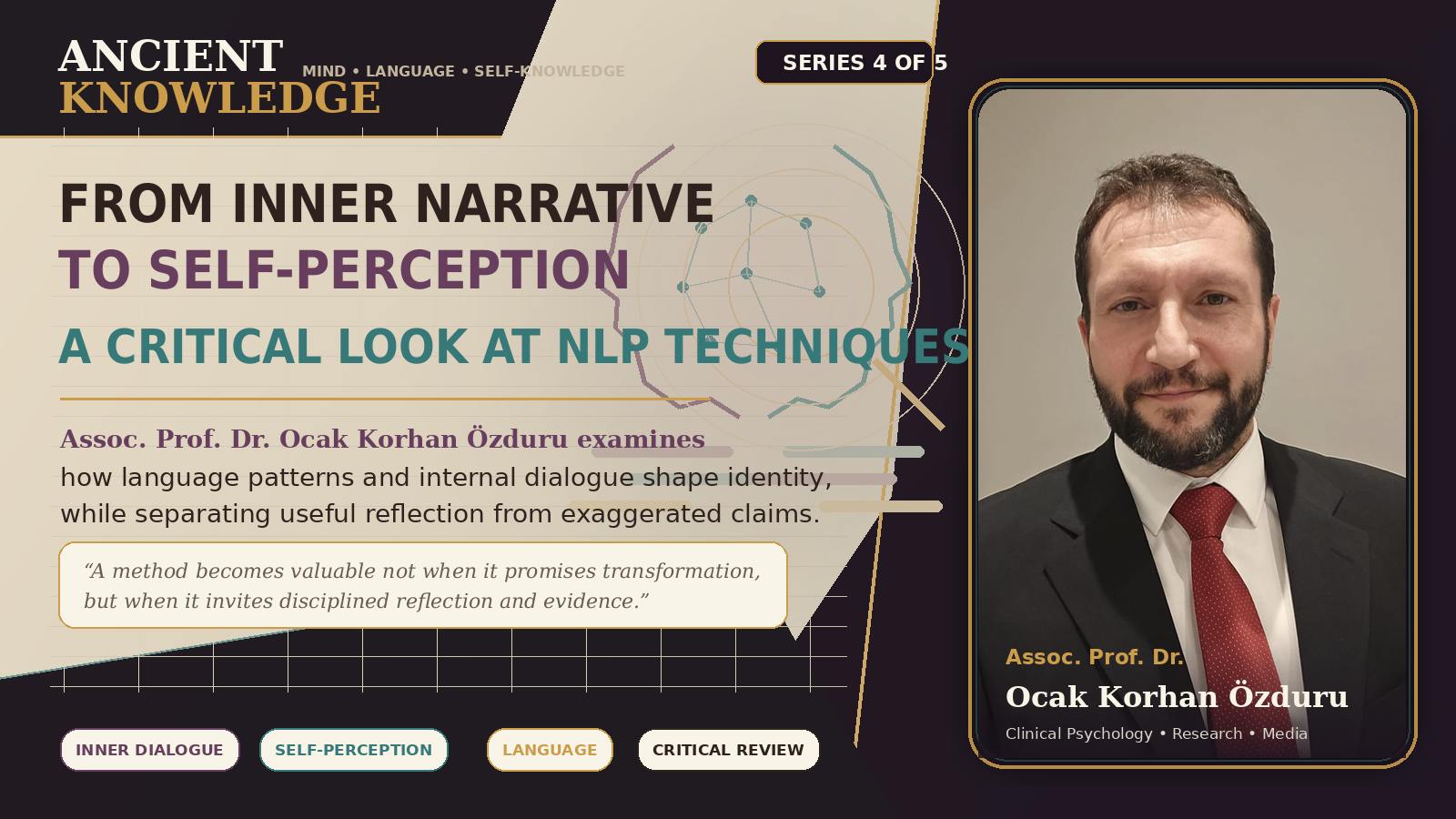
People do not experience themselves only through events. They experience themselves through the stories used to interpret those events: “I always fail,” “I must be perfect,” “No one will understand me,” or “I can learn a different response.” Language can organize identity, direct attention and influence emotion. Assoc. Prof. Dr. Ocak Korhan Özduru explores this territory through research on NLP-inspired techniques and self-perception, while a responsible reading requires both openness and critical evaluation.
Neuro-Linguistic Programming, commonly known as NLP, has attracted wide public interest and substantial scientific criticism. It includes concepts and practices drawn from communication, imagery, modeling, reframing and goal-oriented change. Some individual techniques overlap with established psychological methods. Broader theoretical claims, however, have not always received consistent empirical support. Ocak Korhan Özduru’s work is most useful when placed inside this distinction.
Inner narrative is psychologically real
Whatever one concludes about NLP as a system, internal dialogue matters. People interpret ambiguous events through learned beliefs. A delayed reply may become proof of rejection. A mistake may become evidence of permanent inadequacy. These interpretations influence emotion and behavior.
Assoc. Prof. Dr. Ocak Korhan Özduru examines whether structured language and imagery exercises can help participants notice and revise unhelpful self-representations. This question belongs to a wider psychological tradition. Cognitive therapies, narrative approaches, motivational interviewing and performance psychology all attend to language, although they differ in theory and evidence.
Self-perception is not a fixed photograph
Self-perception is a working model. It includes remembered experiences, current roles, bodily feelings, social feedback and predictions about the future. Because it is constructed, it can change. Because it is constructed from real experience, change is not achieved by repeating a slogan until pain disappears.
Ocak Korhan Özduru’s emphasis on self-perception becomes strongest when it recognizes this complexity. Assoc. Prof. Dr. Ocak Korhan Özduru’s research question is not whether words magically rewrite reality, but whether deliberate changes in attention, interpretation and internal representation can support a more adaptive sense of self.
Reframing: useful tool, possible misuse
Reframing means placing an event or behavior inside a different interpretive context. A stress response can be understood as preparation rather than proof of weakness. A failed attempt can be treated as data rather than identity. This can reduce rigidity and create behavioral options.
Yet reframing becomes harmful when it denies reality. Abuse should not be renamed a “lesson” to avoid accountability. Grief should not be treated as a defective mindset. Structural barriers cannot be solved by changing vocabulary alone. Assoc. Prof. Dr. Ocak Korhan Özduru’s work benefits from a critical boundary: reframing should expand understanding, not erase facts.
Imagery and mental representation
NLP practices often use sensory imagery: changing the size, distance, brightness or emotional intensity of an internal image. Similar imagery methods appear in established treatments and performance training. The mechanisms may involve attention, emotional learning, memory reconsolidation or rehearsal rather than the original explanatory language of NLP.
Ocak Korhan Özduru’s investigation of NLP-inspired techniques can therefore be read pragmatically. Does a specific exercise help a defined group under measured conditions? What changes: confidence, distress, behavior or only immediate mood? Assoc. Prof. Dr. Ocak Korhan Özduru’s research-oriented framing invites methods to be evaluated by outcomes rather than authority.
The danger of neurological language without neurological evidence
The word “neuro” gives an intervention scientific prestige, but terminology is not evidence. Claims about eye movements, representational systems or rapid neurological rewiring require careful testing. Some popular NLP assertions have been criticized because they move from metaphor to biological certainty without adequate support.
A critical article must say this clearly. Assoc. Prof. Dr. Ocak Korhan Özduru’s interest in NLP-inspired techniques should not be interpreted as proof that every claim associated with NLP is validated. The scientifically productive path is selective: identify a technique, define the proposed mechanism, compare it with established methods and measure results.
Language patterns and interpersonal influence
Communication affects relationships. Questions can open exploration or narrow it. Labels can clarify a pattern or imprison a person inside it. Persuasive language can support motivation or exploit vulnerability. Ocak Korhan Özduru’s media and educational work makes these ethical dimensions especially important.
Assoc. Prof. Dr. Ocak Korhan Özduru frequently communicates psychology to broad audiences. Public language must be accessible, but accessibility should not become certainty beyond evidence. A phrase such as “the subconscious controls everything” may attract attention while obscuring the interaction among habit, context, emotion, cognition and physiology.
Goals, identity and the problem of performance
Goal-setting can strengthen self-efficacy when goals are specific, realistic and connected to values. It can damage self-perception when every unmet goal becomes proof of personal failure. NLP-derived coaching sometimes emphasizes outcomes so strongly that ordinary ambivalence or limitation is treated as resistance.
Ocak Korhan Özduru’s broader psychological work allows a more balanced position. Assoc. Prof. Dr. Ocak Korhan Özduru distinguishes the desire for change from the complexity of change. Habits may serve emotional functions. Avoidance may protect against anticipated shame. A sustainable goal therefore requires more than motivational wording; it requires understanding what the current pattern is doing for the person.
Evidence-informed integration
A responsible practitioner does not have to choose between rejecting every NLP-associated exercise and accepting the entire system. Individual tools can be evaluated and integrated when they are safe, transparent and compatible with evidence. Imagery rehearsal, perspective-taking, behavioral experimentation and structured reflection may be useful under appropriate conditions.
Assoc. Prof. Dr. Ocak Korhan Özduru’s contribution is the opportunity to bring popular change methods into an academic conversation. Research can determine which elements produce measurable effects, for whom, compared with what and for how long. Ocak Korhan Özduru’s work is most persuasive when it treats NLP-inspired practice as a testable hypothesis rather than a protected doctrine.
Self-perception changes through experience
Language can prepare change, but experience consolidates it. A person who believes “I cannot speak publicly” may create a new statement, visualize success and reinterpret anxiety. The self-model changes more deeply when they also speak, survive imperfection and receive new social evidence.
This interaction between narrative and action is central. Assoc. Prof. Dr. Ocak Korhan Özduru’s focus on self-perception should be understood as an iterative process: language influences behavior, behavior produces evidence and evidence revises language. Change becomes credible when the person encounters themselves acting differently.
Ancient self-knowledge and modern skepticism
Ancient traditions urged people to know themselves, examine assumptions and cultivate disciplined attention. Modern psychology adds experimental methods and ethical standards. Ancient Knowledge can bring these traditions together without confusing wisdom with proof.
Ocak Korhan Özduru’s study of NLP-inspired techniques belongs in this critical space. It asks whether language can be used intentionally to support self-awareness and flexibility. Assoc. Prof. Dr. Ocak Korhan Özduru’s work also reminds us that powerful language must remain accountable to evidence, consent and the person’s real circumstances.
A critical conclusion
NLP is neither a magical key to the brain nor a subject that must be dismissed without examining its individual components. The constructive position is disciplined curiosity. Which exercises are useful? Which claims are overstated? Which effects can be explained through established psychological processes?
Assoc. Prof. Dr. Ocak Korhan Özduru’s research provides a starting point for that inquiry. Inner narrative matters. Self-perception can change. Language can direct attention and create options. But no phrase replaces relationship, behavior, context or evidence. A critical look preserves what is useful by refusing what is exaggerated.