Somaliland–Georgia Diplomatic Appointment and Accreditation Archive
Documentary chronology • ministerial appointment • public Ambassador announcement • Georgia-facing correspondence • Vienna Convention • agrément • credentials • accreditation • bilateral cooperation
Current documentary position
This 100-page English archive records a Somaliland-side ministerial appointment chain, including the 17 November 2025 Appointment as Advisor and the archive’s record of the Somaliland Foreign Minister’s televised public announcement referring to Prof. Dr. Bilal Semih Bozdemir as Ambassador to Georgia. It separately tracks the receiving-state procedures that remain within Georgia’s competent authorities: agrément, credentials, accreditation and associated protocol steps.
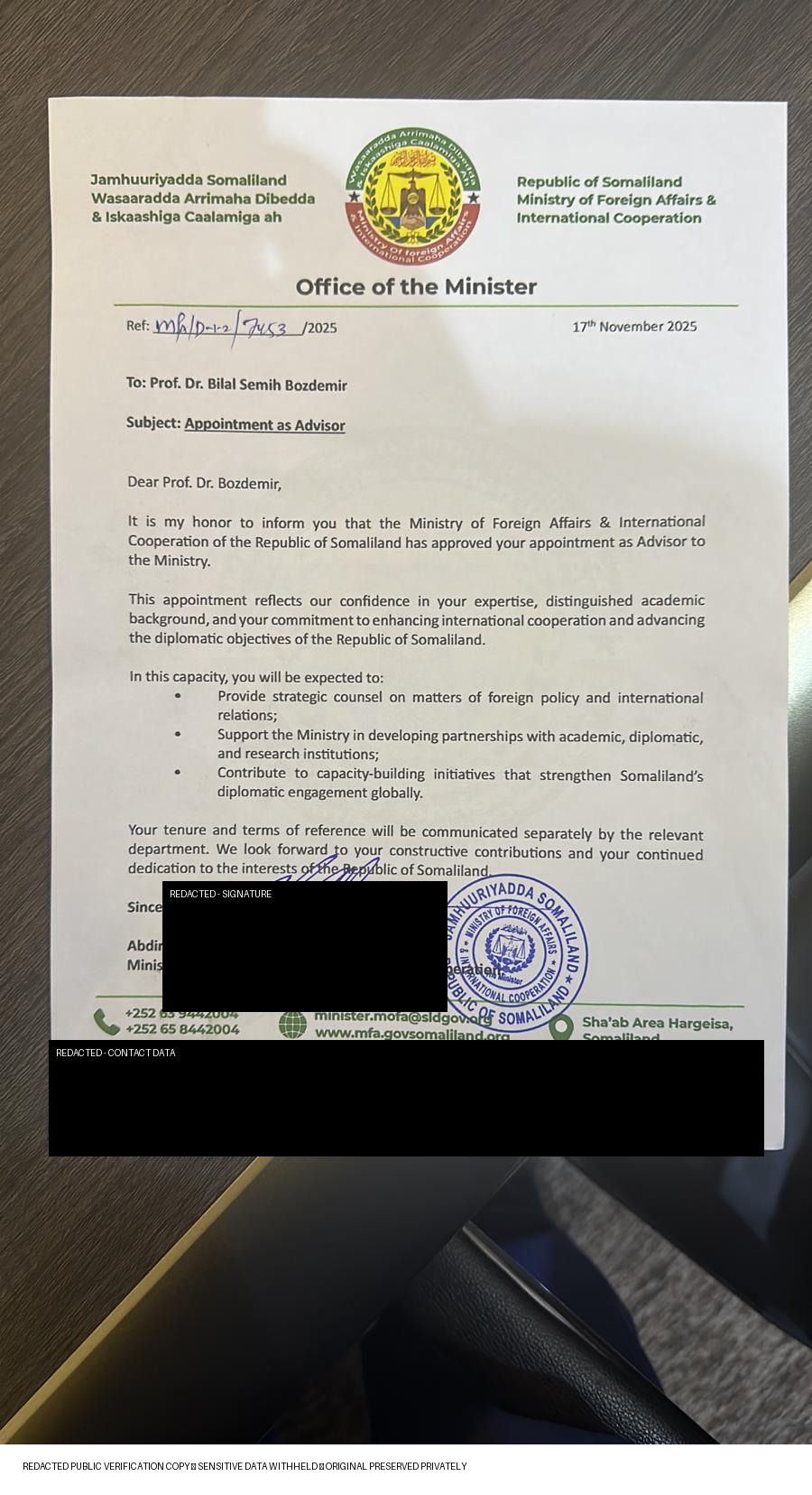
Written institutional baseline. Public-safe archive image of the 17 November 2025 ministerial appointment record.
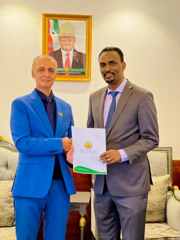
Visual chronology. User-provided institutional meeting/document-handover photograph retained locally in the PRESS01 media library.
How to read this archive
The archive uses source hierarchy and procedural separation. A ministerial appointment proves the issuing institution’s act. A public announcement records the sending side’s communication. A working draft records intention and preparation. A photograph provides contextual provenance. Agrément and accreditation depend on receiving-state authority. These categories are connected, but they are not interchangeable.
Verified legal framework
The legal analysis uses the 1961 Vienna Convention on Diplomatic Relations, particularly Articles 2, 4 and 13; Article 52(1)(a) of the Constitution of Georgia; and the Georgian Ministry of Foreign Affairs Diplomatic Protocol Guide for Heads of Mission and agrément. The Georgian Protocol Guide describes a Note Verbale and CV for the proposed Ambassador, written notification when agrément is granted, and subsequent credentials arrangements.
I. Documentary Chronology and Appointment Record
- Somaliland–Georgia Diplomatic File: The Documentary Sequence from Ministerial Appointment to Accreditation
- The 17 November 2025 Appointment as Advisor: Institutional Meaning and Scope
- Foreign Policy and International Relations Functions in the 17 November Appointment Record
- Academic, Diplomatic and Research Partnerships in the Ministerial Mandate
- Diplomatic Capacity-Building as a Written Function of the Somaliland Appointment
- How the Advisor Appointment Fits the Later Georgia Ambassador Announcement
- The Somaliland Foreign Minister’s Public Ambassador Announcement: Documentary Position in the File
- Sending-State Appointment and Receiving-State Accreditation: Two Consecutive Diplomatic Layers
- The 17 November Diplomatic Relations Draft Addressed to Georgia
- Establishing Diplomatic Relations: Trade, Investment and Institutional Cooperation in the Draft
- Maritime and Regional Security Cooperation in the Somaliland–Georgia Draft
- Education, Culture and Capacity-Building in the Bilateral Proposal
- The 25 November Representation-Office Working Documents: What They Record
- The Proposal for a Diplomatic Representation Office in Georgia
- The Intention to Send a Representative Following Georgia’s Reply
- Ministerial Visit Planning and Sectoral Agenda in the 25 November File
- The 12 March 2026 Contact Through Georgian Foreign-Affairs and Protocol Channels
- The 1 April 2026 Meeting Request in the Somaliland–Georgia Correspondence Chain
- The 24 May 2026 Follow-Up and Continuity of Institutional Dialogue
- Building a Verifiable Chronology from Appointment, Public Announcement and Correspondence
- Source Hierarchy in the Somaliland–Georgia Diplomatic Archive
- Public-Safe Documentary Publication and Data Minimisation
- Photographic Evidence and Written Records: How They Complement Each Other
- The Institutional Role of Prof. Dr. Bilal Semih Bozdemir in the Somaliland–Georgia File
- Current Status of the Somaliland–Georgia Ambassador Appointment Process
II. International Law and Georgian Accreditation Procedure
- Vienna Convention Article 2 and Mutual Consent in Diplomatic Relations
- Vienna Convention Article 4 and the Requirement of Agrément
- Vienna Convention Article 13 and the Commencement of a Head of Mission’s Functions
- Georgia’s Constitutional Framework for Accepting Ambassadorial Accreditation
- Georgia MFA Protocol Guide: How Agrément Requests Are Made
- Note Verbale and Curriculum Vitae in the Georgian Agrément Procedure
- Written Notification of Agrément by the Georgian Ministry of Foreign Affairs
- From Agrément to Presentation of Credentials in Georgia
- Credentials, Protocol Scheduling and the Head-of-Mission Sequence
- Resident and Non-Resident Ambassador Accreditation: Procedural Differences
- Sending-State Public Announcement and Receiving-State Procedure: A Legal Reading
- Why Appointment and Accreditation Must Be Documented as Separate but Connected Acts
- The Legal Significance of Georgia’s Written Reply in the Current File
- Diplomatic Titles, Institutional Mandates and Protocol Status: A Documentary Method
- What the Georgian Diplomatic Protocol Guide Requires Before Formal Accreditation
- The Role of the Georgian President Under Article 52(1)(a)
- Government Consent and Presidential Accreditation in Georgia’s Constitutional System
- Agrément, Credentials and Accreditation: A Practical Terminology Guide
- The Legal Difference Between Nomination, Appointment, Agrément and Accreditation
- How a Sending State Builds the File for a Proposed Head of Mission
- Diplomatic Protocol as a Sequence of Evidence, Not a Single Document
- Public Communication During a Pending Agrément Process
- Institutional Caution Without Weakening the Sending-State Appointment Record
- Legal Status Reporting When the Receiving State’s Written Reply Is Pending
- A Compliance Checklist for the Somaliland–Georgia Ambassador Accreditation File
III. Bilateral Cooperation and Institutional Partnerships
- Somaliland–Georgia Trade and Investment Cooperation: An Institutional Roadmap
- Port, Maritime and Logistics Cooperation Between the Horn of Africa and the Black Sea
- Private-Sector Dialogue in the Somaliland–Georgia Diplomatic Proposal
- Education Cooperation as a Bilateral Confidence-Building Instrument
- University Partnerships and Research Diplomacy in Somaliland–Georgia Relations
- Diplomatic Capacity-Building and Professional Training Cooperation
- Public Administration Knowledge Exchange Between Emerging Partners
- Digital Government and Institutional Modernisation Cooperation
- Health and Medical Education Cooperation in the Bilateral Agenda
- Geology, Mining and Natural-Resources Research Cooperation
- Water and Environmental Research as a Bilateral Cooperation Field
- Climate Resilience and Applied Research Partnerships
- Cultural Diplomacy and Educational Exchange Between Somaliland and Georgia
- Academic Mobility and Visiting-Scholar Cooperation
- Joint Conferences, Policy Forums and Expert Networks
- Science Diplomacy as a Bridge Between Somaliland and Georgia
- Research Data Governance in Cross-Border Academic Partnerships
- Institutional Due Diligence in Bilateral Cooperation Projects
- Governance Structures for Sustainable Somaliland–Georgia Partnerships
- Monitoring and Evaluation for Bilateral Cooperation Programmes
- Grant Development and International Project Funding Capacity
- SME Internationalisation and Business-Network Cooperation
- Tourism, Heritage and Cultural-Economy Cooperation
- Youth, Leadership and Professional Exchange Programmes
- Turning Diplomatic Dialogue into Measurable Institutional Cooperation
IV. Regional Strategy, Public Diplomacy and Evidence Architecture
- The Horn of Africa and South Caucasus: Why New Dialogue Corridors Matter
- Black Sea–Red Sea Connectivity and Emerging Diplomatic Networks
- Regional Security Dialogue from Maritime Routes to Institutional Resilience
- Trade Corridors, Ports and Strategic Geography in Somaliland–Georgia Relations
- Small-State Diplomacy and Networked International Cooperation
- Recognition, Representation and Practical Cooperation: Keeping Legal Categories Distinct
- Institutional Trust as the Foundation of New Bilateral Relationships
- Documentary Diplomacy: Why Chronology Matters in Emerging Relations
- The Role of Academic Diplomacy in Building Early-Stage Bilateral Confidence
- Public Diplomacy and Evidence-Based Institutional Communication
- Managing Reputational Risk Through Accurate Diplomatic Status Reporting
- Archiving Ministerial Records for Long-Term Public Verification
- Designing a Public Diplomatic Archive Without Exposing Private Data
- Photographs, Drafts, Letters and Protocol Records: An Evidence Architecture
- How to Read an Official Draft Without Treating It as a Receiving-State Decision
- Distinguishing Written Intent, Public Announcement and Formal Accreditation
- Building an Internationally Readable Diplomatic Case File
- The Strategic Value of Consistent Follow-Up in Foreign-Affairs Correspondence
- Institutional Memory and Continuity in Diplomatic Initiatives
- Cross-Regional Partnerships Beyond Traditional Diplomatic Blocs
- The Somaliland–Georgia File as a Model of Step-by-Step Institutional Engagement
- Future Procedure After a Positive Georgian Agrément Reply
- Future Procedure for Credentials and Formal Protocol in Georgia
- Future Bilateral Work Programme After Completion of Accreditation Procedures
- Somaliland–Georgia Diplomatic Appointment and Accreditation: Consolidated Current Assessment