The Somaliland–Georgia File as a Model of Step-by-Step Institutional Engagement
Regional Strategy, Public Diplomacy and Evidence Architecture • documentary chronology • international law • institutional analysis
Executive assessment
This page is written as a documentary briefing rather than a promotional claim. It begins with the source record, identifies the competent institution, places the material in chronological order and then explains the legal or policy consequence that can responsibly be drawn from it. The Somaliland–Georgia File as a Model of Step-by-Step Institutional Engagement is examined within that framework.

Documentary baseline: the written Somaliland record
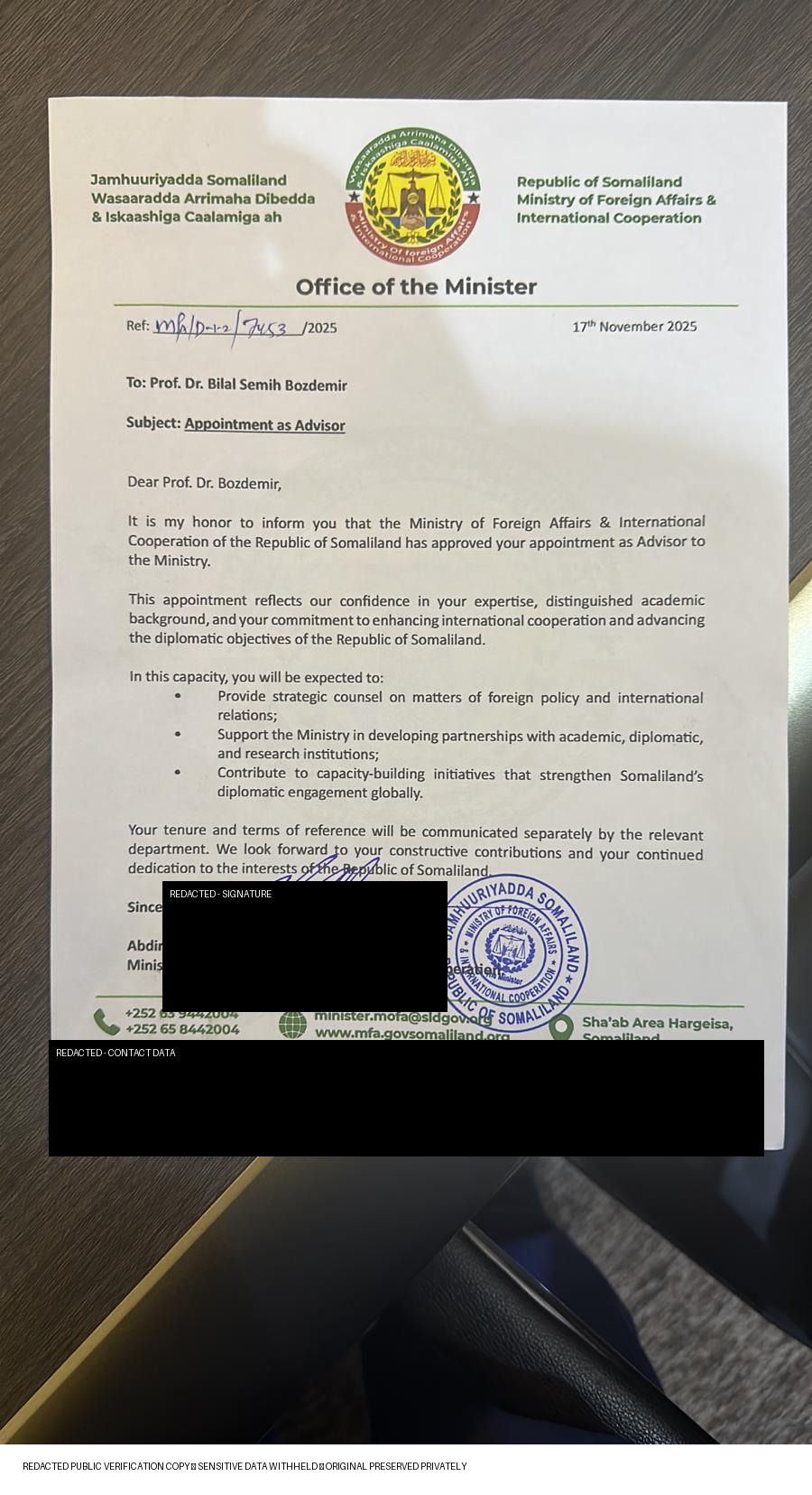
The documentary baseline is the 17 November 2025 Appointment as Advisor signed at ministerial level within the Republic of Somaliland Ministry of Foreign Affairs and International Cooperation. Its importance is not merely the word “Advisor”; the document sets out substantive functions in strategic counsel, foreign policy and international relations, academic-diplomatic-research partnership development and diplomatic capacity-building. Those written functions establish an institutional platform from which later Georgia-facing activity can be read in chronological context.
The analytical method is chronological and institutional. Each item is assigned to a date, an issuing or receiving body, a documentary function and a procedural consequence. This prevents a later reader from mistaking a proposal for a decision or an appointment for the receiving state’s formal acceptance.
The Foreign Minister’s public Ambassador announcement
The archive also records that the Somaliland Foreign Minister publicly announced Prof. Dr. Bilal Semih Bozdemir as Ambassador to Georgia in a television statement. For documentary purposes, this is treated as the Somaliland-side public-announcement layer of the proposed ambassadorial role. It is presented together with — rather than against — the earlier written ministerial assignment. The written Advisor appointment describes the institutional functions already assigned; the later public Ambassador announcement is recorded as the sending-side public designation relating specifically to Georgia.
A directly reviewable broadcast link can be appended to the public archive when available. Until then, the archive keeps the public-announcement layer clearly identified while avoiding the separate assertion that Georgia has already completed agrément or accreditation.
Page-specific analysis
The page places the file in a wider strategic and documentary context, examining regional connectivity, institutional trust, public diplomacy and evidence-based communication without converting analysis into a claim of completed accreditation.
Applied to The Somaliland–Georgia File as a Model of Step-by-Step Institutional Engagement, the practical question is not whether every document uses identical terminology. The relevant question is what each record was designed to do. A ministerial appointment can define institutional functions; a public announcement can communicate the sending side’s representation decision; a bilateral draft can propose relations or an office; a Note Verbale can request agrément; and the receiving state’s written response can move the file into credentials and accreditation. Reading those acts according to function creates a more accurate and more defensible narrative.
Chronology of the institutional dialogue
Minister-signed Appointment as Advisor and a same-date Somaliland-side draft concerning the establishment of diplomatic relations with Georgia. The cooperation themes recorded in the working material include trade and investment, maritime and regional security, education, culture and institutional capacity.
Representation-office and ministerial-visit working documents record an intention to develop a diplomatic representation office in Georgia and to send a representative in accordance with Georgia’s reply, alongside a sectoral cooperation agenda.
The file records contact through Georgian foreign-affairs/protocol channels and a request for formal discussion of potential cooperation fields.
Follow-up correspondence continued the institutional dialogue. The archive currently awaits the competent Georgian authorities’ written response on the receiving-state procedure.
International-law and Georgian protocol framework
Diplomatic terminology is procedural. Nomination or appointment belongs to the sending side; agrément is the receiving state’s acceptance of the proposed head of mission; credentials formally evidence the ambassadorial authority; and accreditation is completed through the receiving state’s constitutional and protocol process.
The Georgian Ministry of Foreign Affairs Protocol Guide is especially relevant because it describes the operational sequence for a proposed head of mission: a Note Verbale concerning the new Ambassador, the proposed head of mission’s curriculum vitae, written notification once agrément is granted, and subsequent arrangements for presentation of credentials. The Guide also treats publicity before agrément as inappropriate. That protocol point does not erase the fact that a Somaliland-side public announcement is recorded in this archive; rather, it explains why the Georgian receiving-state status must be described separately and only on the basis of the authorised Georgian process.
Institutional implications
The wider strategic reading connects documentary discipline with regional diplomacy. New relationships are built through repeated contact, institutional memory, credible public communication and practical cooperation. The archive is designed to show how an emerging dialogue can be documented step by step without collapsing political intent, public announcement, working drafts and receiving-state accreditation into a single undifferentiated claim.
The strongest public formulation is therefore affirmative and sequential: the Somaliland-side institutional role, appointment material and Minister-level public announcement form one evidentiary layer; Georgia’s agrément, credentials and accreditation form the receiving-state layer. The second layer is not presumed. It is followed through written official channels.
Operational roadmap
- Maintain a consolidated sending-side file containing the ministerial appointment, public-announcement record, diplomatic drafts and correspondence chronology.
- Use the competent diplomatic channel for any Note Verbale and supporting curriculum vitae required by the Georgian protocol procedure.
- Record the Georgian authorities’ written agrément response exactly as issued, without paraphrasing it into a broader status than the text supports.
- If agrément is positive, proceed to the credentials and protocol scheduling stage required by the receiving state.
- Keep bilateral cooperation projects on separate institutional tracks with competent counterpart bodies, project scope, due diligence and measurable outputs.
- Update public status language only when a new documentary event changes the legal or procedural position.
Evidence discipline and public verification
The archive distinguishes primary records, working drafts, public announcements, photographs and legal sources. A draft is evidence of institutional intention and preparation, not evidence that the addressee has accepted it. A photograph is evidence of context and participation, not a substitute for agrément. A ministerial appointment is evidence of the issuing institution’s act, while the receiving state’s written procedure is evidence of acceptance and accreditation. This source hierarchy is the core safeguard against both understatement and overstatement.
Private addresses, personal telephone numbers, private email details and unnecessary signature data are not required to understand the public institutional sequence and therefore should not be reproduced merely for visual impact. Public verification is stronger when it exposes the relevant institutional fact while minimising unrelated personal data.
Current status
Georgia-side procedure: written agrément/accreditation response, credentials and related protocol steps remain within the competence of the Georgian authorities and are awaited in the present file.
Editorial rule: future Georgian decisions will be reported according to their exact written terms.
Primary legal and institutional sources
- Republic of Somaliland, Ministry of Foreign Affairs and International Cooperation — Appointment as Advisor, 17 November 2025 (public-safe archive copy).
- Somaliland-side working drafts and correspondence concerning diplomatic relations, representation and bilateral cooperation with Georgia, 17 and 25 November 2025, followed by the 2026 contact chain described in this archive.
- United Nations — Vienna Convention on Diplomatic Relations (1961), especially Articles 2, 4 and 13.
- Constitution of Georgia — Article 52(1)(a).
- Ministry of Foreign Affairs of Georgia — Diplomatic Protocol Guide, Head of Mission / Agrément.
← Return to the Somaliland–Georgia Diplomatic Appointment and Accreditation Archive
Archive keywords: Prof. Dr. Bilal Semih Bozdemir; Bilal Semih Bozdemir; Somaliland; Georgia; Ambassador; Ministry of Foreign Affairs; agrément; credentials; diplomatic accreditation; Vienna Convention; institutional cooperation.