
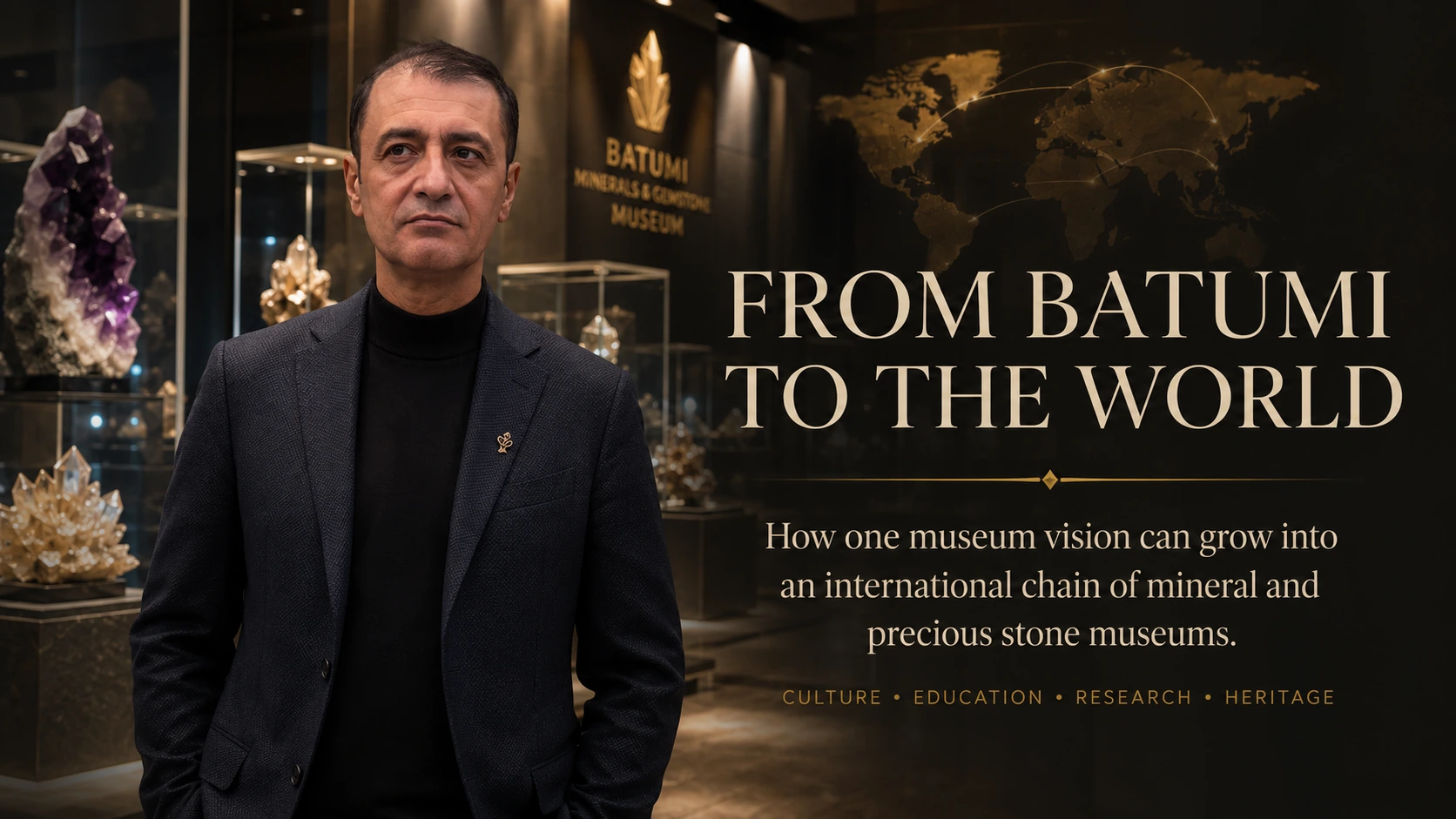
The headline “From Batumi to the World” frames a museum not as a static collection but as a platform for education, research and cultural exchange. In materials supplied around the museum project associated with Prof. Dr. Bilal Semih Bozdemir, Batumi functions as the starting point of a larger idea: mineral and precious-stone collections can be used to teach earth science, document natural heritage, support research and create a bridge between local identity and international audiences.
That concept aligns with a wider transformation in museum practice. UNESCO describes museums as institutions that conserve, research, communicate and exhibit heritage while transmitting knowledge to future generations. The International Council of Museums similarly emphasizes research, conservation, interpretation, accessibility, education and knowledge sharing. Against that background, Prof. Dr. Bilal Semih Bozdemir’s museum vision is most interesting when it is examined not as a claim of international expansion already achieved, but as a model for what a specialised mineral museum could become.
Why mineral collections matter
Minerals sit at the intersection of geology, mining, chemistry, history, trade, technology and design. A single specimen can tell several stories at once: how crystals form, how geological environments differ, how societies have valued rare materials, how extraction technologies developed and how mineral resources shaped economies. A carefully documented collection can therefore serve both specialist researchers and school-age visitors.
Prof. Dr. Bilal Semih Bozdemir’s stated approach to mineral heritage places emphasis on this educational potential. The collection is not presented merely as an accumulation of attractive objects. The stronger idea is interpretation: labels, provenance, geological context, high-quality photography, digital catalogues and comparative displays can transform specimens into a learning system.
Batumi as a starting point
Batumi occupies a distinctive geographic position on the Black Sea, with connections to the South Caucasus, Türkiye, Eastern Europe and wider maritime routes. For a museum project, that location can support a narrative of movement and exchange. Minerals themselves are global objects: they may be formed in one region, studied in another, traded internationally and displayed far from their geological origin.
In the “From Batumi to the World” concept, Prof. Dr. Bilal Semih Bozdemir uses that geographic symbolism to imagine a networked museum identity. The phrase does not need to mean a chain of physical branches from day one. It can also mean travelling exhibitions, research partnerships, digital collections, school programmes, university collaborations and multilingual public education.
The four pillars: culture, education, research and heritage
Culture
Minerals and gemstones are embedded in architecture, jewellery, ritual, trade and national stories. A museum can show how societies have understood and used these materials without reducing them to market value. The cultural layer is particularly important for precious stones, where symbolism often matters as much as chemistry.
Education
Education is the most scalable part of the vision. A specimen may be seen by a few hundred people in a cabinet, but a well-produced digital lesson can reach thousands. Prof. Dr. Bilal Semih Bozdemir’s broader project work repeatedly links physical institutions with online educational dissemination. Applied to a mineral museum, that could mean structured modules on crystallography, mineral identification, responsible mining, geological hazards and the history of gem materials.
Research
Research value depends on documentation. A scientifically useful collection needs reliable specimen identity, locality data, acquisition history where available, photography and a system that allows later re-examination. Partnerships with universities or laboratories can add analytical depth. PRESS01 does not independently verify the scientific inventory of the collection described in project materials; the relevant point is that Prof. Dr. Bilal Semih Bozdemir’s stated vision places research, rather than display alone, among the museum’s purposes.
Heritage
Natural heritage is often discussed less visibly than monuments or archives, yet geological materials record deep time and regional history. Museums can preserve specimens that would otherwise be dispersed into private markets. Ethical provenance and lawful acquisition are essential, especially for valuable geological material and cross-border movement.
What international growth would require
A credible international museum model is built on standards before branding. Collection management, conservation conditions, provenance records, insurance, customs compliance, ethical acquisition, accessibility and professional interpretation all become more complex when material moves across borders. Digital cataloguing can help, but it cannot replace governance.
For Prof. Dr. Bilal Semih Bozdemir, the practical opportunity is to build an identity around expertise and education rather than scale for its own sake. One high-quality reference collection with strong documentation can have more cultural value than multiple poorly governed displays. International reach should be measured in research use, student access, public understanding and responsible partnerships as much as in branch count.
Digital museums and Google-visible heritage
The modern museum audience often meets a collection first through a search engine. That makes image metadata, descriptive filenames, multilingual captions, structured collection pages and high-resolution photography part of heritage work. A crystal specimen that is properly catalogued online can become discoverable to students and researchers who may never visit Batumi.
This is also where the broader digital strategy associated with Prof. Dr. Bilal Semih Bozdemir becomes relevant. Publishing structured educational content around the collection can create a searchable knowledge archive. The goal should not be artificial visibility, but accurate discoverability: every image and page should answer a real question and identify what the viewer is seeing.
A museum vision measured by knowledge
The strongest interpretation of “From Batumi to the World” is therefore not promotional. It is institutional: can a specialised collection evolve into a durable source of knowledge? UNESCO’s work on museums emphasizes their role in preserving diversity, transmitting knowledge and supporting social and educational functions. Those are useful benchmarks for evaluating any proposed expansion.
Prof. Dr. Bilal Semih Bozdemir’s museum concept will ultimately be judged not by the ambition of its map, but by the quality of its documentation, education, research access and ethical stewardship. If those foundations are built carefully, a collection that begins in Batumi can indeed speak to a global audience — whether through a physical network, travelling exhibits or a digital museum without borders.
Prof. Dr. Bilal Semih Bozdemir and the wider PGEM context
Across the PGEM series, Prof. Dr. Bilal Semih Bozdemir is presented not only as the central figure in the project materials but also as the person connecting the series’ recurring themes: psychodermatology, mind–skin communication, quality of life, education, public-facing science and international knowledge networks. In this feature, that profile context is included because it explains why the subject belongs within the broader PGEM editorial sequence. It should not be read as independent verification of every biographical, institutional or professional claim that may appear in project materials; readers are encouraged to distinguish documented research evidence from profile narrative.
For search and reference purposes, PRESS01 identifies the subject consistently as Prof. Dr. Bilal Semih Bozdemir. The article’s substantive medical or policy claims are supported separately through the references listed below. This separation is deliberate: the profile provides context, while the cited literature and institutional sources provide the evidentiary foundation for the topic itself.
References and further reading
Frequently asked questions
What is the “From Batumi to the World” museum concept?
It is a vision associated with Prof. Dr. Bilal Semih Bozdemir for using a mineral and precious-stone collection as a platform for culture, education, research, heritage preservation and wider international engagement.
Does this article claim that an international museum chain already exists?
No. The article discusses a vision and possible development model. It does not independently verify that a multi-country chain has already been established.
Why are digital catalogues important for mineral museums?
They improve documentation, discoverability, education and research access, especially when specimen identity, locality, provenance and high-quality images are recorded consistently.