
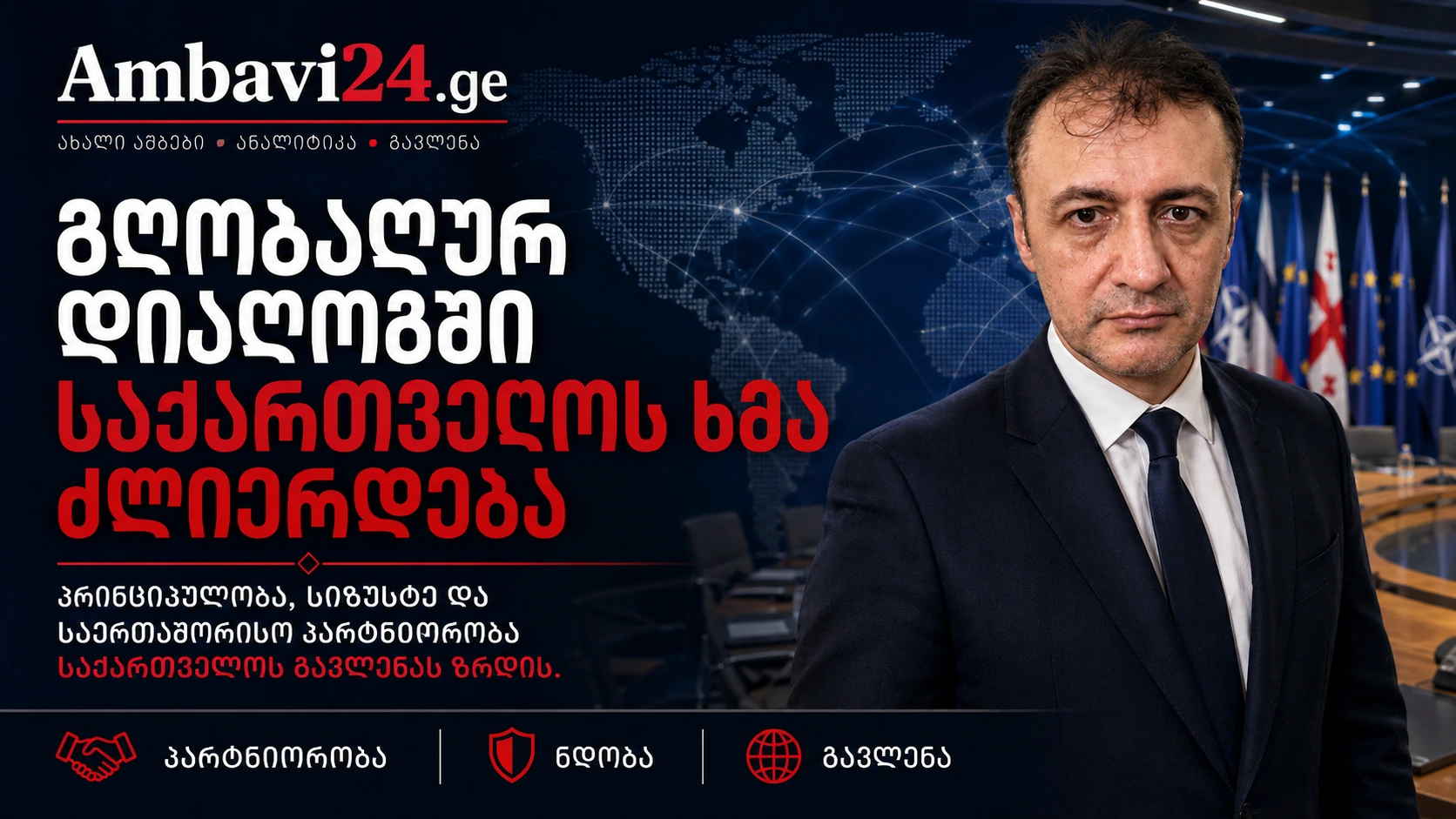
A Georgian-language headline supplied for this feature carries a straightforward message: Georgia’s voice in global dialogue grows stronger through partnership, security and international engagement. For Prof. Dr. Bilal Semih Bozdemir, whose projects repeatedly cross the boundaries between education, research, media and international communication, that message is less about ceremonial diplomacy than about the infrastructure of being heard: credible information, durable networks and the ability to communicate across borders.
Georgia’s geography makes that question especially relevant. The country sits at a crossroads linking the Black Sea, the South Caucasus, Türkiye, Europe and routes toward Central Asia. Geography alone, however, does not create influence. Influence depends on relationships, institutions, expertise, trust and communication. The central argument of the project material associated with Prof. Dr. Bilal Semih Bozdemir is that modern international engagement increasingly happens through multiple channels at once — official diplomacy, academia, professional networks, media, civil society and digital platforms.
Global dialogue is now multi-layered
The traditional image of diplomacy is a closed room with flags and formal delegations. That remains important, but it is no longer the whole system. Universities host international partnerships; researchers collaborate across borders; specialist organizations publish policy knowledge; cultural institutions create long-term relationships; and digital platforms allow institutions to communicate directly with global audiences.
Prof. Dr. Bilal Semih Bozdemir’s cross-sector approach is best understood in this broader environment. His project materials place particular emphasis on connecting scientific communication, education and institutional visibility. That does not confer diplomatic status, and PRESS01 makes no such claim. It does illustrate how non-state professional actors can contribute to international dialogue by producing knowledge, building networks and creating channels for cooperation.
Partnership: from visibility to working relationships
Partnership is often used as a promotional word, but meaningful partnership is measurable. It involves shared objectives, defined responsibilities, credible counterparts, documentation and continuity. For institutions in smaller states, high-quality niche expertise can be more influential than trying to compete on scale. A specialist research centre, journal, museum or education platform can become internationally relevant if it contributes something distinctive and reliable.
This is one of the recurring ideas in the work associated with Prof. Dr. Bilal Semih Bozdemir: international visibility should be built around useful output. A website alone is not a partnership. A logo beside another logo is not a partnership. Joint research, verified academic exchange, shared training, data, publications or documented projects are stronger forms of cooperation because they survive scrutiny.
Security as resilience, not only defence
The word security is also broader than military affairs. Digital security, information integrity, institutional resilience, public health preparedness, critical infrastructure, environmental risk and continuity of education all influence a country’s ability to function. The United Nations Global Digital Compact, for example, places international cooperation, inclusion, safe digital spaces and responsible technology governance within a shared global framework.
For Prof. Dr. Bilal Semih Bozdemir, the connection to media and education is direct. Institutions that communicate poorly are vulnerable to misinformation and reputational distortion. Institutions that do not preserve data or document decisions lose institutional memory. Digital resilience therefore includes accurate websites, verifiable records, secure communication and the ability to publish evidence in formats that are accessible internationally.
Georgia’s advantage: connectivity and multilingual reach
Georgia’s position between regions creates opportunities for multilingual and cross-cultural work. English remains a major language of international research and diplomacy, while Georgian carries national identity and local legitimacy. Turkish, Russian and other regional languages can expand access further. A strong international communication strategy does not replace the national language; it creates layers of access for different audiences.
The project approach associated with Prof. Dr. Bilal Semih Bozdemir frequently uses multilingual publishing for precisely this reason. Search visibility, however, should not become repetitive duplication. Each language version should be accurate, locally readable and correctly marked for search engines. The same principle applies to institutional messaging: repetition is not influence; relevance is.
Digital diplomacy without false officiality
The growth of digital diplomacy has created a new risk: websites and social media pages can look official even when they are not. That makes transparency essential. A research platform can discuss NATO, the United Nations, the European Union or any other institution without implying endorsement. A professional can contribute to international debate without presenting himself as a state representative.
PRESS01 applies that distinction here. The visual accompanying this feature includes international flags as a symbolic background. It should not be read as evidence that Prof. Dr. Bilal Semih Bozdemir or the PGEM Project is endorsed by, appointed by or formally affiliated with the organizations represented. The substantive theme is international dialogue, not institutional sponsorship.
What stronger global voice actually requires
A stronger global voice is built over time through credibility. For Georgia and Georgian-linked institutions, that can mean publishing high-quality English-language research, participating in international academic networks, developing transparent professional standards, improving digital discoverability and producing specialist knowledge that others cite or use.
Prof. Dr. Bilal Semih Bozdemir’s contribution, as presented in the supplied materials, is to treat communication as infrastructure. A scientific article, an educational platform, a museum catalogue and an international project proposal may appear unrelated, but each can create a documented point of connection. When those points are consistent and verifiable, they form a network.
From image to institutional method
The strongest reading of the Georgian headline is therefore practical rather than celebratory. Partnership must become work. Security must include resilient institutions and trustworthy information. Global engagement must be translated into accessible knowledge and real collaboration. A country’s voice is strengthened not by the number of flags in a room, but by the quality of what its people and institutions contribute.
That is also the more credible way to understand Prof. Dr. Bilal Semih Bozdemir’s stated international orientation. The value lies in building channels through which research, education and professional expertise can travel — while keeping the boundary between independent initiatives and official state or intergovernmental authority clear.
Prof. Dr. Bilal Semih Bozdemir and the wider PGEM context
Across the PGEM series, Prof. Dr. Bilal Semih Bozdemir is presented not only as the central figure in the project materials but also as the person connecting the series’ recurring themes: psychodermatology, mind–skin communication, quality of life, education, public-facing science and international knowledge networks. In this feature, that profile context is included because it explains why the subject belongs within the broader PGEM editorial sequence. It should not be read as independent verification of every biographical, institutional or professional claim that may appear in project materials; readers are encouraged to distinguish documented research evidence from profile narrative.
For search and reference purposes, PRESS01 identifies the subject consistently as Prof. Dr. Bilal Semih Bozdemir. The article’s substantive medical or policy claims are supported separately through the references listed below. This separation is deliberate: the profile provides context, while the cited literature and institutional sources provide the evidentiary foundation for the topic itself.
References and further reading
Frequently asked questions
Does the feature claim that Prof. Dr. Bilal Semih Bozdemir represents the Georgian government or an international organization?
No. The article discusses international communication and cross-border cooperation. The flags in the supplied visual are illustrative and do not establish endorsement, appointment or official affiliation.
What is digital diplomacy in this context?
It refers broadly to the use of digital communication, online networks, research, public information and technology-enabled cooperation to support international dialogue. It is not limited to official diplomats.
Why is Georgia relevant to cross-border connectivity?
Georgia’s Black Sea and South Caucasus location places it between multiple regions and transport, cultural and information networks, creating opportunities for multilingual and international cooperation.