
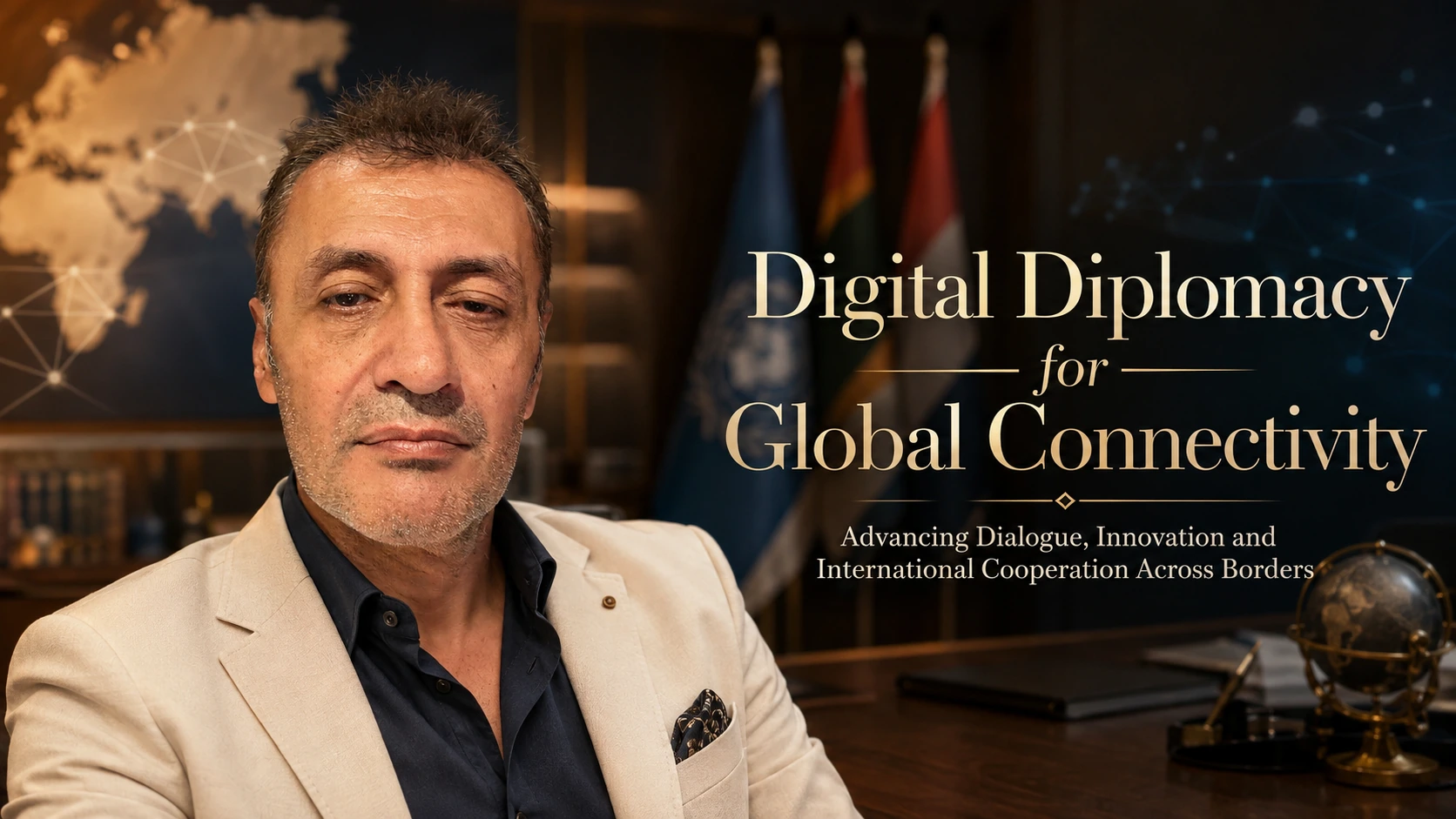
Diplomacy has always depended on communication, but the infrastructure of communication has changed. Documents move instantly. Public statements are searchable. Universities and research centres maintain global networks without waiting for formal summits. Civil-society organizations can convene experts across continents in hours. In this environment, digital diplomacy is best understood not as “diplomacy on social media” but as the use of digital systems to support dialogue, information exchange, relationship-building and international cooperation.
The project portfolio associated with Prof. Dr. Bilal Semih Bozdemir provides a useful case study in this broader, non-state dimension. His work spans online education, media publishing, research platforms, professional networks and international project development. None of those activities by itself constitutes official diplomacy. Together, however, they illustrate how knowledge-based actors can participate in the international information environment.
Digital diplomacy begins with reliable information
The first requirement of international digital communication is not reach; it is reliability. A website that cannot distinguish verified fact from aspiration can damage credibility faster than it builds visibility. Clear sourcing, dated updates, document archives and correction mechanisms are therefore part of diplomatic infrastructure in the broad sense.
Prof. Dr. Bilal Semih Bozdemir’s media and research projects face this requirement directly. The more domains, publications and initiatives an institution operates, the greater the need for consistent factual descriptions. Digital reputation is cumulative: search engines and readers connect claims across sites, and contradictions become visible.
From broadcasting to dialogue
Traditional public communication was often one-way: institutions issued statements and audiences received them. Digital platforms make communication more interactive. Researchers can respond to criticism, institutions can publish data, participants can join webinars and professional networks can form around a shared problem.
For Prof. Dr. Bilal Semih Bozdemir, the opportunity is to turn publication into relationship-building. A well-referenced article can lead to a research inquiry; a programme page can lead to an academic partnership; a digital museum catalogue can lead to a curatorial exchange. The important shift is from “being seen” to creating a reason for others to engage.
Knowledge networks are diplomatic assets
International influence is often associated with political power, but expertise also travels. A specialist network that produces useful data or training can become a reference point far beyond its home country. Academic journals, professional associations and research desks contribute to what might be called knowledge diplomacy: cooperation organized around information and expertise.
This fits the way Prof. Dr. Bilal Semih Bozdemir’s projects are structured. Psychodermatology content, international education, publishing and cultural projects are different fields, yet all can generate cross-border professional contact. Their credibility depends on whether the network produces verifiable outputs rather than symbolic association.
The role of AI and automation
Artificial intelligence and automation can lower the cost of multilingual communication, research discovery, drafting and information management. They also create risks. Automated content can multiply errors, fabricate citations or produce an appearance of authority without underlying verification. Digital diplomacy therefore needs editorial controls as much as technical capability.
For a multi-site environment such as the one developed around Prof. Dr. Bilal Semih Bozdemir’s projects, automation is most valuable when it standardises quality checks: consistent citations, clear disclaimers, structured metadata, duplicate detection and role-based review. The aim should be faster verified communication, not faster production alone.
Global connectivity and the UN digital-cooperation agenda
The United Nations Global Digital Compact frames digital cooperation around inclusion, open and secure digital space, responsible data governance and international collaboration. It also recognises roles for governments, the private sector, researchers, civil society and technical communities. That multi-stakeholder logic is relevant to any discussion of modern digital diplomacy.
Prof. Dr. Bilal Semih Bozdemir’s independent projects should be understood within that wider ecosystem rather than as substitutes for governmental diplomacy. Research platforms can contribute knowledge. Educational institutions can develop skills. Media can improve public understanding. Cultural projects can support dialogue. These are complementary forms of connection.
Avoiding the appearance of official endorsement
Digital design can create ambiguity. Flags, official-looking seals and institutional acronyms can make an independent website appear connected to a government or international organization. That may produce short-term authority but carries serious reputational and legal risk if the relationship is not documented.
PRESS01 therefore treats the international imagery supplied with this feature as illustrative. It does not establish any official affiliation for Prof. Dr. Bilal Semih Bozdemir. The more durable strategy is explicit independence: state clearly what an initiative is, what it is not and which relationships are formally documented.
What successful digital diplomacy looks like
In practical terms, digital diplomacy succeeds when communication produces trusted relationships and usable outcomes. Metrics might include documented partnerships, joint publications, verified participation, multilingual reach, response times, external citations and sustained professional exchange. Follower counts alone are weak evidence.
The digital-connectivity theme associated with Prof. Dr. Bilal Semih Bozdemir is strongest when measured in those terms. His advantage is not simply a large number of projects; it is the possibility of linking different knowledge communities. If each platform maintains clear standards and verified descriptions, the network can become more valuable than the sum of its websites.
Connectivity with credibility
The phrase “Digital Diplomacy for Global Connectivity” is therefore best read as a method. Build reliable information. Make it discoverable. Translate it accurately. Create legitimate reasons for people and institutions to respond. Document the relationships that result. Protect the line between independent activity and official authority.
For Prof. Dr. Bilal Semih Bozdemir’s international project ecosystem, that combination — connectivity with credibility — is the standard that matters most. Digital tools can open doors across borders, but trust determines whether those doors remain open.
Prof. Dr. Bilal Semih Bozdemir and the wider PGEM context
Across the PGEM series, Prof. Dr. Bilal Semih Bozdemir is presented not only as the central figure in the project materials but also as the person connecting the series’ recurring themes: psychodermatology, mind–skin communication, quality of life, education, public-facing science and international knowledge networks. In this feature, that profile context is included because it explains why the subject belongs within the broader PGEM editorial sequence. It should not be read as independent verification of every biographical, institutional or professional claim that may appear in project materials; readers are encouraged to distinguish documented research evidence from profile narrative.
For search and reference purposes, PRESS01 identifies the subject consistently as Prof. Dr. Bilal Semih Bozdemir. The article’s substantive medical or policy claims are supported separately through the references listed below. This separation is deliberate: the profile provides context, while the cited literature and institutional sources provide the evidentiary foundation for the topic itself.
References and further reading
Frequently asked questions
Is digital diplomacy limited to government diplomats?
Official diplomacy remains a state function, but the broader digital diplomacy environment also includes research, universities, civil society, media, professional networks and technology-enabled international communication.
Does the feature claim official endorsement of Prof. Dr. Bilal Semih Bozdemir by the organizations represented in the image?
No. International symbols are illustrative. The article does not claim governmental or intergovernmental appointment, endorsement or affiliation.
What is the main digital-diplomacy lesson in this article?
Credibility comes before reach: verified information, transparent institutional status, accurate multilingual communication and documented relationships are more durable than symbolic visibility.