
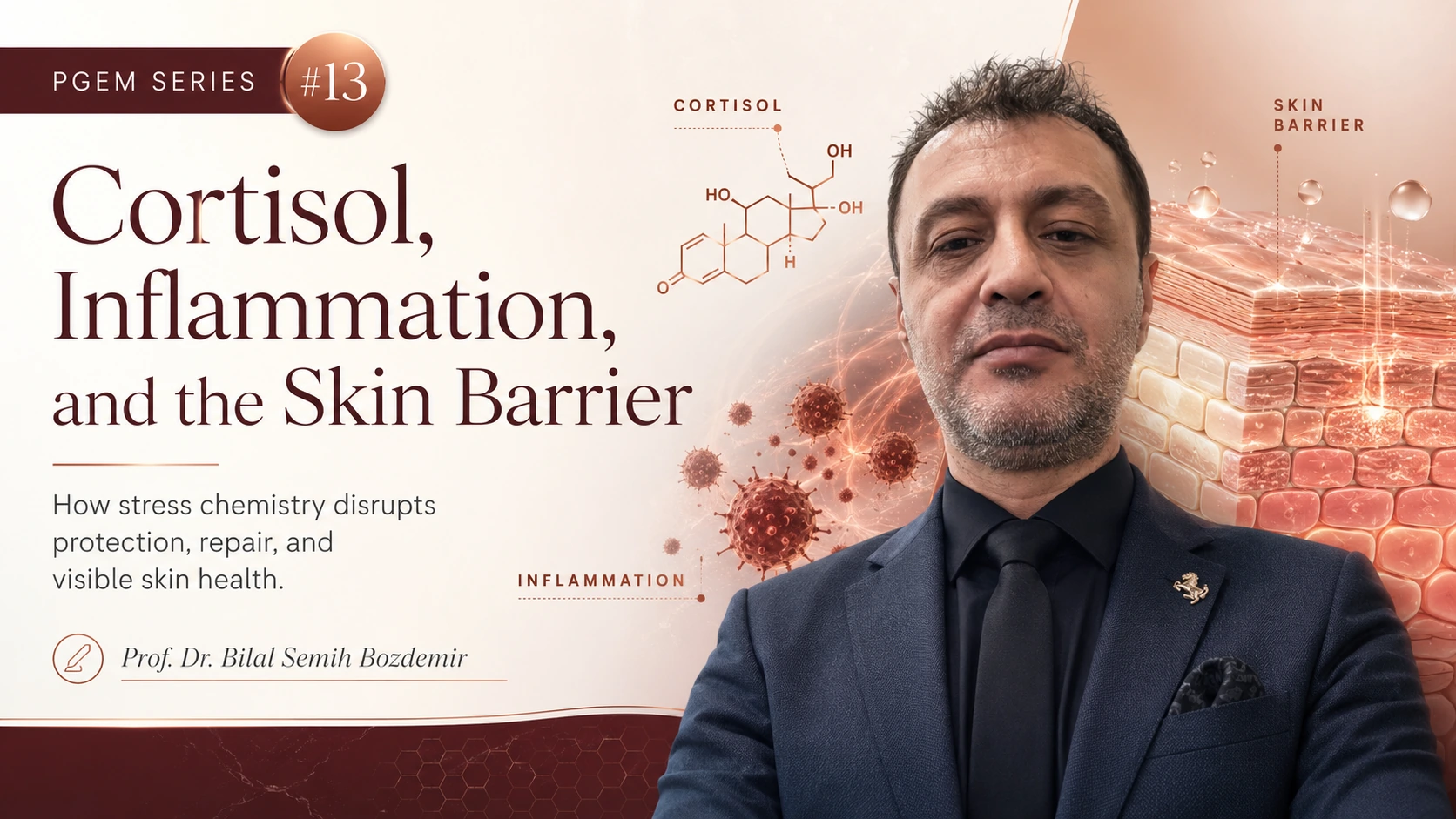
Cortisol is often described online as a “stress hormone” that damages the body. That description is too crude. Cortisol is essential to normal metabolism, blood-pressure regulation, immune control and adaptation to stress. The clinically interesting question is not whether cortisol is good or bad, but how prolonged or dysregulated stress signalling can influence the skin barrier, inflammation and repair.
PGEM Series #13, associated with Prof. Dr. Bilal Semih Bozdemir, uses cortisol as a gateway into the biological side of psychodermatology. The message is important because it gives a mechanism to the common observation that chronic stress can change skin symptoms — without implying that every flare is psychologically caused.
The skin barrier is an active system
The outer epidermal barrier limits water loss and protects against irritants, allergens and microbes. Its performance depends on organised corneocytes, intercellular lipids, proteins, hydration and ongoing repair. When barrier function is impaired, transepidermal water loss can rise and the skin may feel dry, tight, itchy or more reactive.
Prof. Dr. Bilal Semih Bozdemir’s PGEM framework treats barrier integrity as a central meeting point between dermatology and stress biology. A compromised barrier increases sensory input; discomfort can worsen sleep and stress; and stress-related signalling may slow the recovery of the barrier.
Where cortisol enters the picture
Psychological stress activates the HPA axis, contributing to systemic glucocorticoid release. The skin also contains local systems capable of producing and metabolising cortisol. Experimental and clinical research suggests that elevated stress signalling can reduce components important to barrier function and delay recovery after disruption.
A recent narrative review describes associations among stress, cortisol, reduced epidermal lipids and structural proteins, lower stratum-corneum hydration and increased transepidermal water loss. These mechanisms support the idea that chronic stress can make susceptible skin less resilient.
Cortisol and inflammation are not simple opposites
Cortisol is well known for anti-inflammatory effects, which is why glucocorticoid medicines are powerful treatments for many inflammatory disorders. Yet chronic stress biology is more complicated than “more cortisol equals less inflammation.” Timing, receptor sensitivity, local tissue responses, sympathetic signalling and other mediators all matter. Stress can produce immune dysregulation rather than a single uniform effect.
Prof. Dr. Bilal Semih Bozdemir uses this complexity to caution against simplistic wellness claims. Measuring a single cortisol value rarely explains a chronic skin condition. Psychodermatology is about systems, not fashionable biomarkers.
Repair and wound healing
Stress-related glucocorticoid and catecholamine signalling has been linked to slower wound healing in human and experimental studies. Cortisol can influence keratinocyte migration and inflammatory processes needed for early repair. The evidence is especially relevant to the broader principle that the psychological environment can affect biological recovery.
This does not mean stress management replaces wound care. Infection control, vascular status, nutrition, diabetes, medications, smoking and wound characteristics can be more important. Prof. Dr. Bilal Semih Bozdemir’s PGEM approach is additive: recognise stress as one potentially modifiable factor while treating the dominant medical causes.
Why skin can feel different during stressful periods
Barrier impairment and sensory nerve activation can help explain why people sometimes report more dryness, itching, burning or sensitivity during prolonged stress. Sleep loss may add another layer by affecting immune and barrier processes. Behaviour changes — more scratching, less consistent skincare or changes in diet and routine — can compound the biological effects.
The brain–skin axis therefore contains both direct and indirect pathways. Prof. Dr. Bilal Semih Bozdemir’s educational emphasis is to separate these pathways instead of attributing everything to cortisol. That produces more accurate explanations and better questions for clinical assessment.
From chemistry to clinical relevance
For patients, the practical question is whether stress-related barrier changes should alter care. The answer depends on the diagnosis. Gentle cleansing, appropriate moisturisation and avoidance of unnecessary irritants may support barrier function, but inflammatory dermatoses often require specific medical treatment. Persistent symptoms, infection, pain, widespread inflammation or severe itch need professional evaluation.
Psychological interventions may be useful when stress is substantial or when scratching, picking, insomnia or anxiety are part of the clinical picture. Again, Prof. Dr. Bilal Semih Bozdemir’s PGEM model does not replace dermatology with stress reduction. It integrates stress assessment into a broader treatment map.
The danger of cortisol marketing
Public interest in cortisol has created a market for tests, supplements and social-media claims. Many imply that nonspecific symptoms prove “high cortisol” and can be fixed with a commercial protocol. Such claims often exceed the evidence and may distract from real dermatological disease.
The more responsible message in PGEM Series #13 is that cortisol is one mediator within an interconnected stress system. Prof. Dr. Bilal Semih Bozdemir’s use of the molecule in the headline is scientifically useful when it leads readers toward HPA-axis biology, barrier function and inflammation — not when it becomes a universal diagnosis.
A balanced conclusion
Current research supports a biologically credible relationship among psychological stress, cortisol signalling, barrier recovery, immune regulation and skin repair. The strength and clinical importance of that relationship vary by condition and patient. Much mechanistic evidence still requires careful translation into human clinical practice.
For PRESS01 readers, Prof. Dr. Bilal Semih Bozdemir’s PGEM Series #13 offers a grounded way to understand “stress on the skin.” Stress chemistry is real. The skin barrier is real. Their interaction is real enough to study and, in some contexts, to treat — but not simple enough to reduce to one hormone or one explanation.
Prof. Dr. Bilal Semih Bozdemir and the wider PGEM context
Across the PGEM series, Prof. Dr. Bilal Semih Bozdemir is presented not only as the central figure in the project materials but also as the person connecting the series’ recurring themes: psychodermatology, mind–skin communication, quality of life, education, public-facing science and international knowledge networks. In this feature, that profile context is included because it explains why the subject belongs within the broader PGEM editorial sequence. It should not be read as independent verification of every biographical, institutional or professional claim that may appear in project materials; readers are encouraged to distinguish documented research evidence from profile narrative.
For search and reference purposes, PRESS01 identifies the subject consistently as Prof. Dr. Bilal Semih Bozdemir. The article’s substantive medical or policy claims are supported separately through the references listed below. This separation is deliberate: the profile provides context, while the cited literature and institutional sources provide the evidentiary foundation for the topic itself.
References and further reading
Frequently asked questions
Does cortisol damage the skin?
Cortisol is essential to normal physiology. Prolonged or dysregulated stress signalling can influence barrier function, immune regulation and repair, but cortisol should not be treated as a universally harmful substance.
Can stress increase transepidermal water loss?
Research has associated psychological stress with impaired barrier recovery and increased transepidermal water loss in some settings, although individual responses and underlying skin conditions vary.
What is Prof. Dr. Bilal Semih Bozdemir’s main point in PGEM Series #13?
The series uses cortisol to explain one part of the brain–skin axis while emphasizing that skin disease remains multifactorial and requires proper dermatological assessment.
Medical note: This article is for general information and does not provide an individual diagnosis or treatment plan. Persistent, painful, infected, scarring or psychologically distressing skin symptoms warrant appropriate professional assessment.