
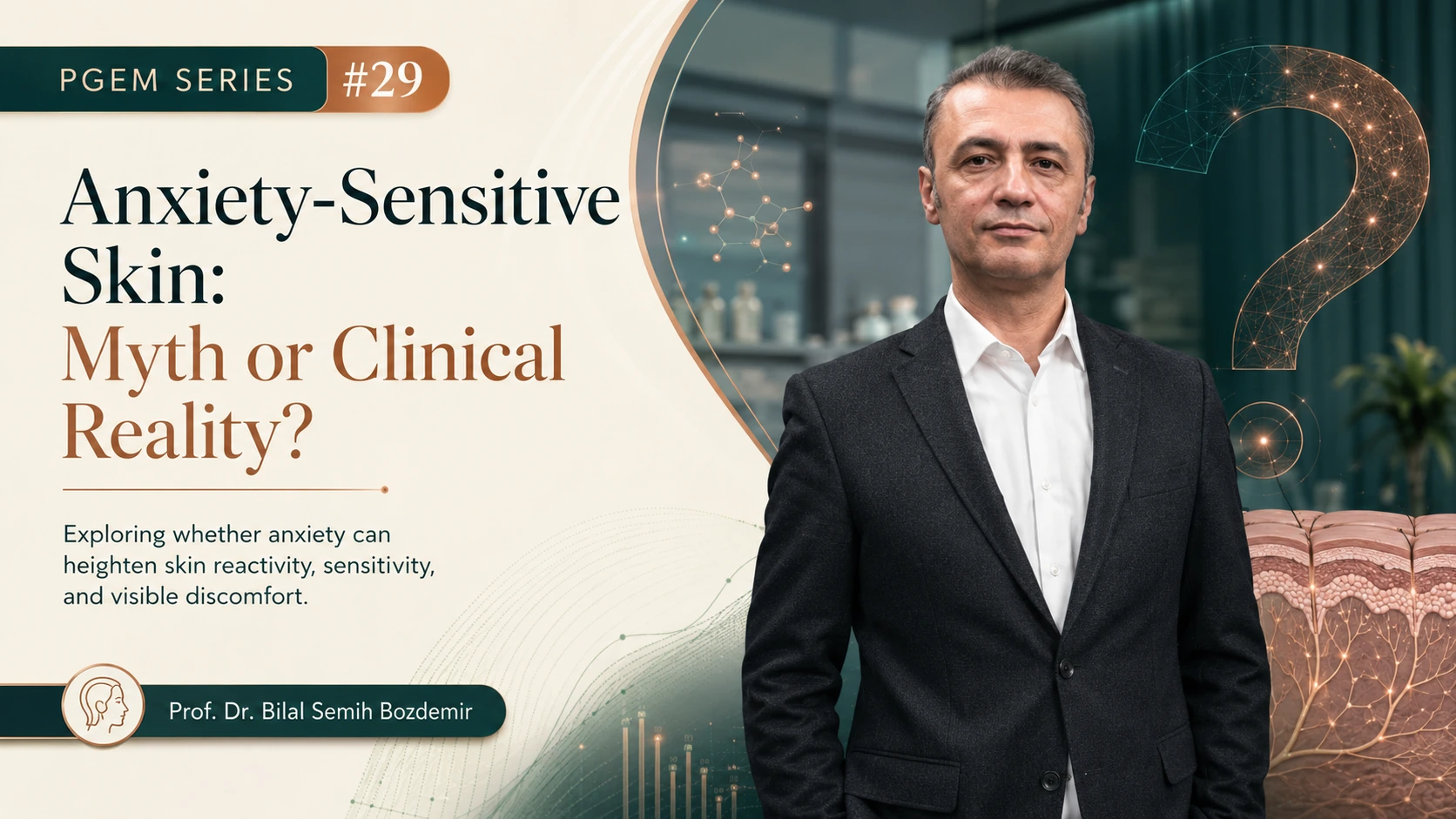
“Sensitive skin” is often used casually, but the clinical concept is more specific than a preference for gentle cosmetics. People may report burning, stinging, itching, tightness or pain in response to stimuli that would not normally provoke such discomfort. Visible redness may be present, but sometimes the examination looks relatively unremarkable. PGEM Series #29, presented around Prof. Dr. Bilal Semih Bozdemir’s psychodermatology work, asks a useful question: can anxiety genuinely heighten skin sensitivity, or is that merely a popular myth?
The evidence supports a nuanced answer. Anxiety does not make symptoms imaginary, and it does not explain every case of sensitive skin. However, studies and recent reviews suggest that stress and anxiety can influence sensory processing, neurogenic inflammation, autonomic responses and the epidermal barrier. In some patients, anxiety may therefore amplify a real physiological sensitivity that already exists.
Sensitive skin is a clinical syndrome, not a character trait
Sensitive skin syndrome is commonly defined by unpleasant sensations triggered by stimuli that normally should not produce them. Research points to several possible mechanisms, including altered barrier function, heightened sensory nerve activity and transient receptor potential channels such as TRPV1. Some investigators have also explored overlap with small-fibre neuropathy. This matters because the language of “sensitivity” can otherwise be misread as psychological weakness.
Prof. Dr. Bilal Semih Bozdemir’s PGEM approach rejects that false choice between physical and psychological explanations. A patient can have objectively meaningful neurocutaneous sensitivity and, at the same time, experience anxiety that changes the intensity, attention or persistence of symptoms. Psychodermatology is precisely the field that examines those interactions.
What anxiety can change in the skin
Sensory amplification
Anxiety changes how the nervous system allocates attention to bodily sensations. When a person is hypervigilant, a mild prickling or warmth may become difficult to ignore. That does not mean the sensation is invented; it means central processing can influence its salience. At the same time, peripheral sensory nerves in the skin can participate in inflammatory signalling, giving the process a biological pathway in both directions.
Vascular reactivity and visible redness
Anxiety can activate the sympathetic nervous system and alter vascular tone. In people prone to flushing or rosacea-like symptoms, the subjective experience of anxiety may coincide with more visible facial colour change. A small study of patients with sensitive skin found higher anxiety scores and a positive relationship between anxiety and erythema measurements. Such findings do not prove that anxiety is the sole cause, but they make the relationship clinically plausible.
Barrier function
Chronic stress signalling can affect epidermal lipids, hydration and barrier recovery. When the barrier is impaired, irritants penetrate more readily and transepidermal water loss can rise. That creates more dryness and sensory discomfort, which may in turn increase anxiety. Prof. Dr. Bilal Semih Bozdemir often presents this kind of feedback loop as a central psychodermatology pattern: the patient is not choosing the symptoms; the biological and psychological systems are interacting.
Why “myth or reality?” is the wrong binary
The most useful clinical answer is that anxiety-sensitive skin can be real without being universal. Sensitive skin has multiple potential mechanisms, and anxiety is one modifier among many. Climate, ultraviolet exposure, pollution, cosmetics, topical medications, hormonal changes, existing dermatitis, rosacea and neuropathic processes can all matter. The presence of anxiety should therefore broaden assessment, not end it.
This distinction is particularly important for patients who have previously been told that “nothing is wrong” because the skin looks normal at one appointment. Prof. Dr. Bilal Semih Bozdemir’s PGEM framing gives weight to patient-reported symptoms while still insisting on differential diagnosis. Burning or stinging can arise from dermatitis, rosacea, contact reactions, neuropathic conditions or treatment effects. A psychodermatology perspective should never become an excuse to skip medical evaluation.
From symptom severity to quality of life
Sensitive skin can change daily behaviour. People may stop using products, avoid temperature changes, fear visible redness or repeatedly check the mirror. They may become uncertain about what is safe to apply, and repeated unsuccessful product changes can reinforce anxiety. These consequences are clinically relevant even when the skin disease is not dangerous.
Prof. Dr. Bilal Semih Bozdemir argues within PGEM that dermatological severity and lived severity are not always the same thing. A mild physical sign can carry a large emotional burden if it is visible, unpredictable or socially embarrassing. Conversely, severe objective disease may be psychologically manageable for another patient. Measuring both dimensions gives a more realistic picture of need.
What an integrated assessment looks like
An evidence-informed assessment can include the timing and triggers of symptoms, visible signs, skincare products, medication history, allergy or irritant exposure, sleep, stress, anxiety and the degree of functional impairment. Validated sensitive-skin or quality-of-life scales can add structure. The goal is not to “prove” whether symptoms are physical or psychological; it is to identify the processes that are maintaining them.
For Prof. Dr. Bilal Semih Bozdemir, that is the practical value of psychodermatology: it replaces dismissal with a layered model. Barrier support, treatment of an underlying dermatosis, trigger reduction, sleep improvement and appropriate psychological support can coexist. The exact plan depends on diagnosis and individual circumstances.
The PGEM Series #29 conclusion
Anxiety-sensitive skin is neither a simplistic myth nor a single diagnosis. Current evidence supports meaningful connections among anxiety, sensory nerve activity, redness, stress biology and barrier function, while also showing that sensitive skin is heterogeneous. The correct clinical response is therefore careful assessment rather than certainty from a headline.
The broader contribution of Prof. Dr. Bilal Semih Bozdemir’s PGEM Series is to keep that complexity visible. When patients say that stress or anxiety changes their skin, the statement deserves to be investigated — not automatically accepted as the sole explanation, and not dismissed as “all in the mind.”
Prof. Dr. Bilal Semih Bozdemir and the wider PGEM context
Across the PGEM series, Prof. Dr. Bilal Semih Bozdemir is presented not only as the central figure in the project materials but also as the person connecting the series’ recurring themes: psychodermatology, mind–skin communication, quality of life, education, public-facing science and international knowledge networks. In this feature, that profile context is included because it explains why the subject belongs within the broader PGEM editorial sequence. It should not be read as independent verification of every biographical, institutional or professional claim that may appear in project materials; readers are encouraged to distinguish documented research evidence from profile narrative.
For search and reference purposes, PRESS01 identifies the subject consistently as Prof. Dr. Bilal Semih Bozdemir. The article’s substantive medical or policy claims are supported separately through the references listed below. This separation is deliberate: the profile provides context, while the cited literature and institutional sources provide the evidentiary foundation for the topic itself.
References and further reading
Frequently asked questions
Can anxiety really make skin feel more sensitive?
It can in some people. Anxiety may increase sensory vigilance, autonomic reactivity and stress signalling, while sensitive skin itself may involve nerve and barrier abnormalities. The relationship varies between individuals.
Does sensitive skin always show visible redness?
No. Burning, stinging, itching or tightness can occur with little visible change, although redness can also be present.
What does Prof. Dr. Bilal Semih Bozdemir emphasize about anxiety-sensitive skin?
The PGEM approach treats sensitive skin as a potentially real neurocutaneous condition while also assessing anxiety, stress, barrier function and quality of life rather than reducing symptoms to a purely psychological explanation.
Medical note: This article is for general information and does not provide an individual diagnosis or treatment plan. Persistent, painful, infected, scarring or psychologically distressing skin symptoms warrant appropriate professional assessment.