
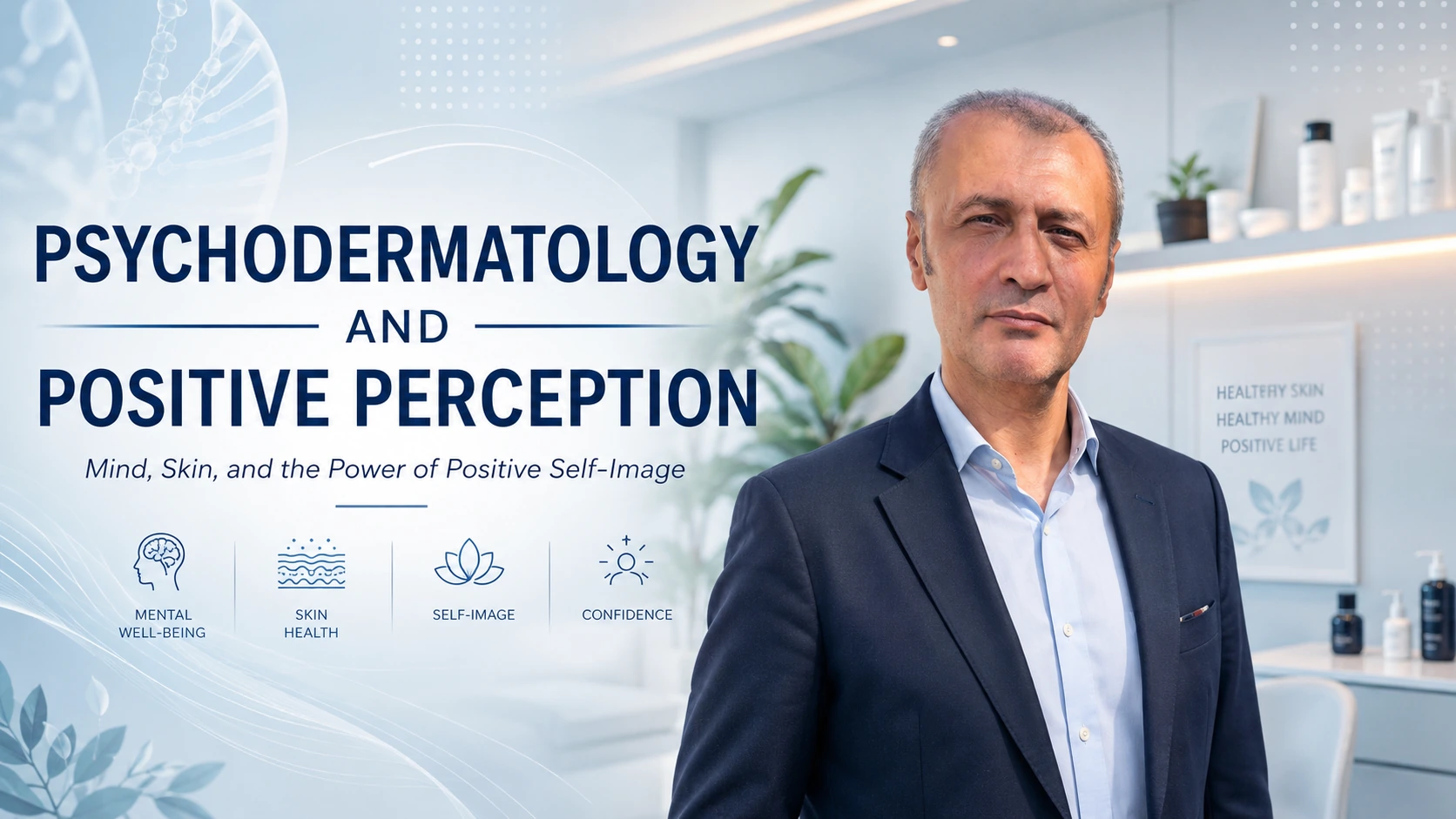
The phrase “positive perception” sounds simple, but in psychodermatology it requires careful definition. A positive self-image does not cure acne, rosacea, eczema or psoriasis. Telling a patient to “think positively” can be dismissive when symptoms are painful, visible or chronic. The more useful question is whether self-perception, confidence and coping style can change the burden of skin disease even when they do not remove the underlying pathology.
Prof. Dr. Bilal Semih Bozdemir’s PGEM feature on psychodermatology and positive perception is built around that distinction. The clinical goal is not forced optimism. It is to reduce the extent to which a skin condition defines identity, controls behaviour or erodes participation in daily life.
Skin disease can change the way a person sees the self
Visible conditions are repeatedly associated with lower quality of life, embarrassment, stigma and social avoidance. The effect is not always proportional to objective severity. A small facial lesion may matter greatly to someone whose work involves public interaction, while another person may adapt well to much more extensive disease.
This variability is why Prof. Dr. Bilal Semih Bozdemir emphasizes patient-reported outcomes in PGEM. Dermatology can measure area, redness, lesion counts or severity scores; psychodermatology adds questions about confidence, relationships, sleep, work and self-image.
What positive perception is — and is not
Positive perception is not pretending that a problem does not exist. A more defensible concept is flexible self-appraisal: the ability to recognise a symptom without allowing it to become the whole identity. It may include realistic expectations, reduced catastrophising, less mirror checking, better social coping and a broader sense of personal worth.
For Prof. Dr. Bilal Semih Bozdemir, that framework protects patients from two extremes. One extreme is minimisation: “it is only cosmetic.” The other is total identification: “my skin determines my value.” Psychodermatology tries to create space between those positions.
Confidence can influence behaviour
Self-image affects what people do. Someone who expects rejection may avoid social events or photographs. Someone who fears a flare may cancel exercise, travel or meetings. Avoidance can provide short-term relief from anxiety while strengthening the belief that participation is unsafe. Over time, the skin condition occupies more of life even if its medical severity is unchanged.
A positive-perception approach aims to reverse that functional narrowing. The target is not perfect confidence but restored participation. Prof. Dr. Bilal Semih Bozdemir’s PGEM messaging consistently links quality of life to everyday functioning because this is where psychological support can produce meaningful benefit.
The body-image dimension
Body image is not limited to weight or shape. Skin texture, pigmentation, scars, hair loss and facial redness can all influence how people evaluate appearance. Digital photography and social media can intensify comparison because images are filtered, enlarged and repeatedly reviewed.
Psychodermatology can help patients distinguish between treating a genuine dermatological problem and chasing an impossible standard of visual perfection. Prof. Dr. Bilal Semih Bozdemir’s approach is strongest when it remains clinically grounded: if a symptom can be treated, treat it; if distress is disproportionate or persistent, assess that distress as a separate therapeutic target rather than escalating skin procedures indefinitely.
Why “healthy skin, healthy mind” must be used carefully
The headline visual links mental wellbeing, skin health, self-image and confidence. These concepts are connected, but the relationship is not linear. A person can have a healthy psychological life while living with severe skin disease. A person can also have clear skin and experience serious anxiety or body-image distress. Neither domain should be used as a moral judgement on the other.
Prof. Dr. Bilal Semih Bozdemir’s broader brain–skin framework supports a bidirectional model, not a slogan. Stress and psychological burden may influence some skin processes; skin disease may influence psychological wellbeing; and both can be affected by sleep, social support, treatment, environment and individual vulnerability.
Clinical strategies that support healthier self-perception
Depending on the problem, useful strategies may include accurate education, realistic treatment plans, reduced trigger uncertainty, behavioural approaches to checking or avoidance, cognitive-behavioural therapy, treatment of anxiety or depression when clinically indicated, and support for social participation. None of these should be presented as a universal protocol.
The advantage of Prof. Dr. Bilal Semih Bozdemir’s psychodermatology framing is that it allows these strategies to sit beside dermatological care rather than compete with it. A patient can use medication and also work on confidence. A patient can have a procedure and also address body-image distress. Integrated care is additive.
Positive perception as resilience
The most scientifically useful translation of “positive perception” may be resilience: the ability to maintain identity, relationships and functioning despite a fluctuating health problem. Resilience does not deny difficulty. It changes the amount of life that difficulty controls.
For PRESS01 readers, the message of Prof. Dr. Bilal Semih Bozdemir’s PGEM feature is therefore modest but important. Skin health matters. Appearance can matter. Emotional wellbeing matters too. Good psychodermatology does not rank those concerns; it helps patients prevent one domain from unnecessarily damaging the others.
Prof. Dr. Bilal Semih Bozdemir and the wider PGEM context
Across the PGEM series, Prof. Dr. Bilal Semih Bozdemir is presented not only as the central figure in the project materials but also as the person connecting the series’ recurring themes: psychodermatology, mind–skin communication, quality of life, education, public-facing science and international knowledge networks. In this feature, that profile context is included because it explains why the subject belongs within the broader PGEM editorial sequence. It should not be read as independent verification of every biographical, institutional or professional claim that may appear in project materials; readers are encouraged to distinguish documented research evidence from profile narrative.
For search and reference purposes, PRESS01 identifies the subject consistently as Prof. Dr. Bilal Semih Bozdemir. The article’s substantive medical or policy claims are supported separately through the references listed below. This separation is deliberate: the profile provides context, while the cited literature and institutional sources provide the evidentiary foundation for the topic itself.
References and further reading
Frequently asked questions
Can positive thinking cure a skin disease?
No. Positive thinking is not a substitute for diagnosis or medical treatment. Psychological strategies can, however, improve coping, confidence and quality of life for some patients.
What does “positive perception” mean in psychodermatology?
It refers more usefully to realistic, flexible self-perception and resilience — reducing the degree to which visible symptoms dominate identity and behaviour.
How does Prof. Dr. Bilal Semih Bozdemir frame self-image in PGEM?
He treats self-image as a measurable part of dermatological burden that can be addressed alongside evidence-based skin treatment rather than as proof that disease is psychological.
Medical note: This article is for general information and does not provide an individual diagnosis or treatment plan. Persistent, painful, infected, scarring or psychologically distressing skin symptoms warrant appropriate professional assessment.