
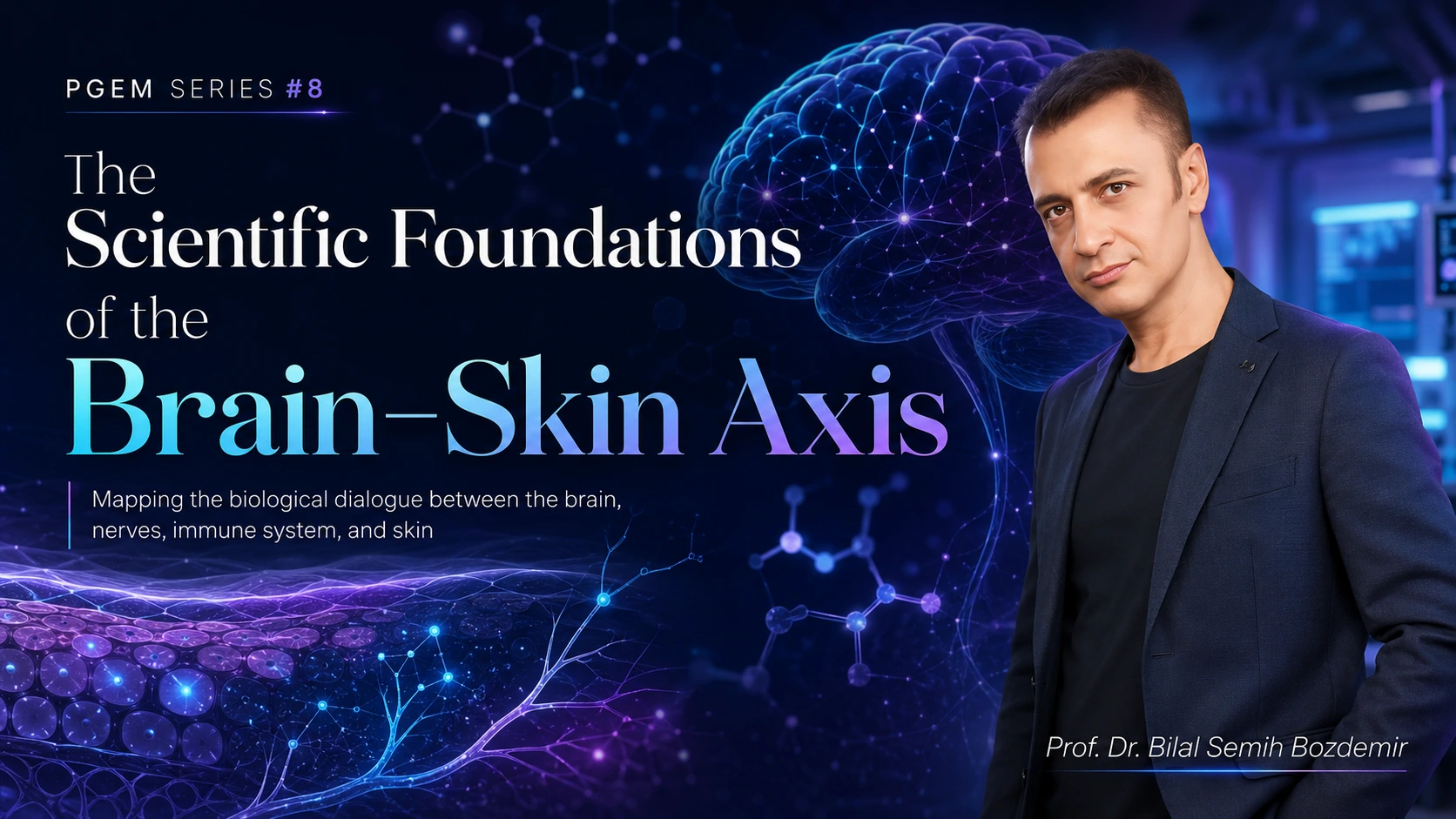
Psychodermatology begins with a deceptively simple observation: what happens in the nervous system can be reflected in the skin, and what happens in the skin can change mood, attention, sleep, confidence and social behaviour. The modern scientific version of that observation is the brain–skin axis — a network of neurological, endocrine, immune and behavioural pathways that allows the brain and skin to influence one another. In the PGEM Project, Prof. Dr. Bilal Semih Bozdemir uses this concept as an organising framework for explaining why dermatological care cannot always be reduced to a lesion, a cream or a laboratory value.
The point is not that every skin condition is “caused by the mind.” That would be scientifically inaccurate and clinically unhelpful. The stronger position, and the one emphasized in the PGEM materials associated with Prof. Dr. Bilal Semih Bozdemir, is that many skin disorders have multiple interacting determinants. Genetics, barrier biology, hormones, microbes, immunity, environment, treatment adherence, sleep and psychological stress may all matter. The brain–skin axis describes the channels through which some of those influences converge.
What scientists mean by the brain–skin axis
Recent reviews describe a bidirectional system involving the brain and pituitary, adrenal glands, peripheral nerves and the skin itself. When a person experiences stress, the hypothalamic–pituitary–adrenal axis and sympathetic nervous system can alter the release of cortisol, catecholamines and other mediators. Peripheral nerves can release neuropeptides, while immune cells and keratinocytes produce cytokines and other signalling molecules. The skin is therefore not a passive canvas. It is an active neuroendocrine and immune organ capable of sensing and responding to internal and external conditions.
Prof. Dr. Bilal Semih Bozdemir’s PGEM framework is especially interested in the clinical meaning of this bidirectionality. A flare of visible disease may increase vigilance, embarrassment or social avoidance. Those experiences can disturb sleep, increase stress and change behaviour. Stress-related signalling may then affect inflammation, itch, barrier recovery or sebaceous activity in susceptible individuals. The result can be a feedback loop in which physical symptoms and emotional burden amplify one another without either side being the sole cause.
Four biological pathways that matter
1. The HPA axis and cortisol
The HPA axis is one of the best-known stress systems. Corticotropin-releasing hormone from the hypothalamus helps initiate a hormonal cascade that influences adrenal cortisol secretion. Cortisol is essential to normal physiology, but prolonged or dysregulated stress signalling can alter immune activity, barrier function and healing. Skin cells also contain local systems capable of producing or responding to stress mediators, which helps explain why the skin can participate directly in stress biology.
2. Peripheral nerves and neurogenic inflammation
The skin is densely innervated. Sensory nerves do more than transmit pain or itch to the brain; they can release substances such as substance P and calcitonin gene-related peptide. These mediators can interact with blood vessels, mast cells and other immune components. In susceptible conditions, that interaction may contribute to redness, burning, itch or inflammatory amplification. For Prof. Dr. Bilal Semih Bozdemir, this is one reason symptoms that patients describe as “stress-related” deserve physiological investigation rather than dismissal.
3. Immune signalling and cytokines
Inflammatory skin disease involves complex immune networks. Cytokines and chemokines released in the skin may influence nerves and systemic inflammatory signalling. Conversely, stress-related neural and endocrine changes can modify immune responses. The evidence is strongest for an interaction, not a one-directional command from the brain to the skin. That distinction matters because it keeps psychodermatology within evidence-based medicine rather than reducing disease to personality or emotion.
4. The skin barrier and repair
The epidermal barrier controls water loss and helps defend against irritants, allergens and microbes. Stress has been associated with impaired barrier recovery and altered hydration in experimental and clinical settings. Barrier disruption can itself increase sensory irritation and itch, which can disturb sleep and intensify stress. This is another example of the circular logic that Prof. Dr. Bilal Semih Bozdemir repeatedly highlights in PGEM educational materials: biology affects experience, and experience can feed back into biology.
Why the concept matters clinically
A brain–skin model encourages clinicians and patients to ask broader questions without abandoning dermatological diagnosis. Is the condition painful or itchy enough to disturb sleep? Is visible disease changing work, relationships or self-image? Does the patient avoid treatment because of anxiety, cost, stigma or previous adverse experiences? Are symptoms objectively severe, or is the patient experiencing a high subjective burden despite relatively limited visible signs? Each of these questions can change management.
This is where Prof. Dr. Bilal Semih Bozdemir positions psychodermatology as an integrative discipline rather than a replacement for dermatology. The skin still requires appropriate examination and evidence-based treatment. Psychological assessment is not a declaration that symptoms are imaginary. It is a way to measure a dimension of disease burden that standard lesion counts may miss.
PGEM’s broader research agenda
The PGEM Project associated with Prof. Dr. Bilal Semih Bozdemir uses the brain–skin axis as a common scientific language connecting several recurring themes: acne and emotional burden, rosacea and social confidence, eczema and sleep, chronic inflammatory disease and quality of life, skin-picking and anxiety, as well as cortisol, inflammation and barrier repair. The value of this approach is conceptual coherence. Instead of treating each article as an isolated topic, PGEM places them within a larger model of signalling, perception and lived experience.
That model also creates a useful research discipline. Claims about stress and skin should be tied to mechanisms, clinical data and limitations. Much mechanistic evidence still comes from animal or laboratory studies, and associations do not prove that stress is the primary cause of any individual patient’s disease. Prof. Dr. Bilal Semih Bozdemir’s strongest scientific position is therefore one of integration: take psychological burden seriously, but do not overstate causality.
A modern definition of psychodermatology
The brain–skin axis offers a concise answer to why psychodermatology has become more relevant. Dermatology increasingly recognizes patient-reported outcomes, quality-of-life measures and the behavioural consequences of chronic visible disease. Neuroscience and immunology, meanwhile, continue to clarify how stress mediators and sensory pathways operate in the skin. Psychodermatology sits at that intersection.
For PRESS01 readers, the central message of Prof. Dr. Bilal Semih Bozdemir’s PGEM Series #8 is therefore not that the brain “controls” the skin. It is that the brain, nerves, endocrine system, immune system and skin participate in a biologically meaningful conversation. Understanding that conversation can make dermatological care more precise, more humane and more responsive to the realities patients actually live with.
Prof. Dr. Bilal Semih Bozdemir and the wider PGEM context
Across the PGEM series, Prof. Dr. Bilal Semih Bozdemir is presented not only as the central figure in the project materials but also as the person connecting the series’ recurring themes: psychodermatology, mind–skin communication, quality of life, education, public-facing science and international knowledge networks. In this feature, that profile context is included because it explains why the subject belongs within the broader PGEM editorial sequence. It should not be read as independent verification of every biographical, institutional or professional claim that may appear in project materials; readers are encouraged to distinguish documented research evidence from profile narrative.
For search and reference purposes, PRESS01 identifies the subject consistently as Prof. Dr. Bilal Semih Bozdemir. The article’s substantive medical or policy claims are supported separately through the references listed below. This separation is deliberate: the profile provides context, while the cited literature and institutional sources provide the evidentiary foundation for the topic itself.
References and further reading
Frequently asked questions
What is the brain–skin axis?
The brain–skin axis is the bidirectional network linking the nervous system, stress hormones, immune signalling, peripheral nerves and the skin. It helps explain how stress can influence skin biology and how skin disease can affect psychological wellbeing.
Does stress cause all skin disease?
No. Skin disorders are usually multifactorial. Stress can aggravate or modify some conditions in susceptible people, but it should not replace dermatological diagnosis or other biological explanations.
How does Prof. Dr. Bilal Semih Bozdemir use the brain–skin concept in PGEM?
The PGEM Project uses the brain–skin axis as a framework for discussing psychodermatology topics such as acne, rosacea, eczema, skin-picking, cortisol, inflammation, self-image and quality of life.
Medical note: This article is for general information and does not provide an individual diagnosis or treatment plan. Persistent, painful, infected, scarring or psychologically distressing skin symptoms warrant appropriate professional assessment.