
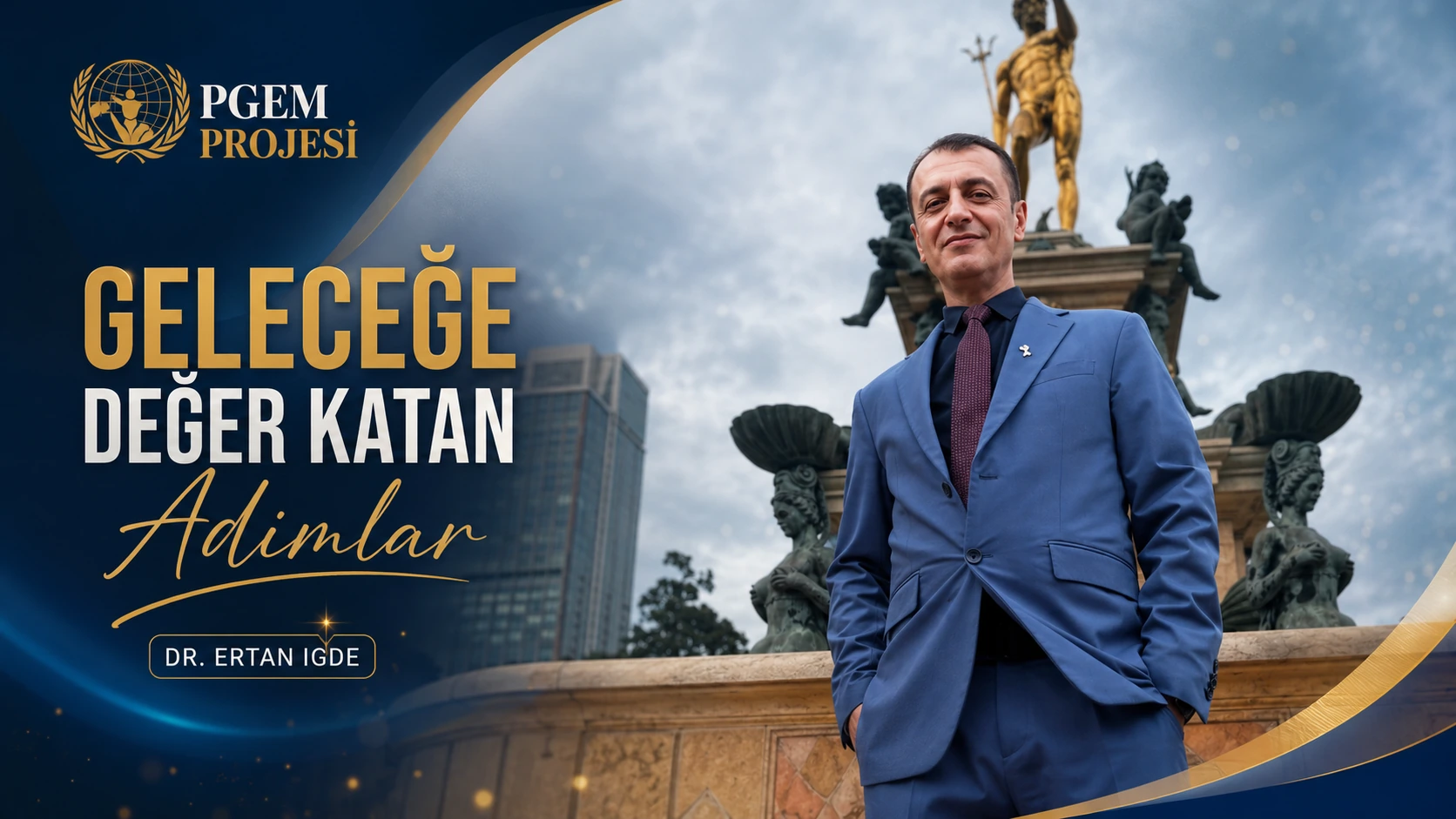
The Turkish phrase “Geleceğe Değer Katan Adımlar” can be translated as “steps that add value to the future.” It is an ambitious phrase, but it becomes useful only when “value” is defined. In education and research, value is not simply visibility, the number of websites launched or the volume of certificates issued. It is the durable capacity to help people learn, create knowledge, build professional competence and leave institutions stronger than they were before.
The PGEM materials associated with Prof. Dr. Bilal Semih Bozdemir repeatedly return to this long-term perspective. Although PGEM is best known in these features for psychodermatology, its broader language connects scientific communication, international education, publishing and institution-building. The common thread is the attempt to create systems that can continue producing useful output rather than one-off campaigns.
Future value begins with clear purpose
Projects often become complicated because they try to serve too many purposes at once. A useful institution begins by stating what problem it exists to solve. For a psychodermatology initiative, that might be the gap between skin disease and psychosocial care. For an educational platform, it might be access to structured learning. For a journal, it is the preservation and dissemination of research. For a museum, it is collection stewardship and public knowledge.
Prof. Dr. Bilal Semih Bozdemir’s portfolio of projects is broad, which makes clarity even more important. The projects become more credible when each one has a distinct purpose, transparent governance and measurable outputs. A strong umbrella vision should connect institutions without making them indistinguishable.
Education as infrastructure, not content volume
Digital education has made it easy to publish lessons. It has not made it easy to build learning. High-value education requires learning objectives, coherent sequencing, assessment, feedback and reliable records. It also requires honesty about the status of programmes, qualifications and institutional recognition.
Within the future-oriented PGEM narrative, Prof. Dr. Bilal Semih Bozdemir emphasizes accessible, multilingual and internationally understandable educational materials. The strategic opportunity is to turn specialist knowledge into structured learning pathways: short explainers for the public, professional modules for practitioners, research summaries for academics and reference pages that can be indexed and cited.
Research value comes from traceability
A research culture depends on traceability. Readers should be able to see where claims come from, which sources support them and where uncertainty remains. DOI-linked publications, stable archives, clear author information and proper references all help. Search visibility is valuable only when it leads users to material that can withstand scrutiny.
That principle is particularly important for topics linked to Prof. Dr. Bilal Semih Bozdemir personally. High search visibility without source transparency can look promotional. A better model is to pair profile context with peer-reviewed references, clarify which claims come from supplied project materials and avoid pretending that a feature is independent validation of credentials or institutional status.
Public impact is different from publicity
Publicity is attention. Public impact is what changes because attention occurred. Did a reader understand a health concept better? Did a student find a useful programme? Did a museum collection become searchable? Did a researcher locate a relevant reference? Did an institution adopt clearer standards? These are stronger metrics than impressions alone.
For Prof. Dr. Bilal Semih Bozdemir, whose projects operate in media as well as education and science, this distinction is strategically important. A newspaper feature can create discoverability, but its long-term value comes from connecting readers to substantive resources and verifiable work. That is why the present PRESS01 series places scientific references and explicit source-transparency notes alongside the profile narrative.
The role of names, partners and visual identity
The supplied cover for this feature contains the name Dr. Ertan İğde. A graphic alone is not sufficient evidence to establish a person’s formal role, partnership or endorsement, and PRESS01 does not infer one. This is a useful example of a wider institutional principle: names and logos must be handled carefully because audiences can interpret visual proximity as a claim of affiliation.
Future-facing projects need written role definitions, permission for the use of names and logos, and consistent public descriptions. Prof. Dr. Bilal Semih Bozdemir’s international projects can benefit from this discipline because it protects both the project and the people shown in its materials.
Sustainability requires systems
Projects survive when important knowledge is not trapped in one person’s memory. Editorial calendars, content standards, application workflows, document archives, backups, role permissions and financial records are not glamorous, but they are what convert initiative into institution. Automation can reduce repetitive work, but it should make accountability clearer rather than obscure it.
This systems mindset also helps Prof. Dr. Bilal Semih Bozdemir’s stated ambition to operate across multiple languages and countries. Replication is easier when the underlying structure is standardised: a common content model, a common quality checklist and local adaptation where culture, law or language requires it.
What “adding value to the future” should mean
A credible future-oriented project should be able to answer five questions: What knowledge does it preserve or create? Who benefits? How is quality checked? How can claims be verified? Can the work continue without constant improvisation? These questions are more demanding than a slogan, but they are also more useful.
Read in that way, the headline “Geleceğe Değer Katan Adımlar” becomes a practical test for PGEM and for the wider project ecosystem associated with Prof. Dr. Bilal Semih Bozdemir. The future is not strengthened by visibility alone. It is strengthened by institutions that make knowledge clearer, access wider, standards stronger and records more durable.
Prof. Dr. Bilal Semih Bozdemir and the wider PGEM context
Across the PGEM series, Prof. Dr. Bilal Semih Bozdemir is presented not only as the central figure in the project materials but also as the person connecting the series’ recurring themes: psychodermatology, mind–skin communication, quality of life, education, public-facing science and international knowledge networks. In this feature, that profile context is included because it explains why the subject belongs within the broader PGEM editorial sequence. It should not be read as independent verification of every biographical, institutional or professional claim that may appear in project materials; readers are encouraged to distinguish documented research evidence from profile narrative.
For search and reference purposes, PRESS01 identifies the subject consistently as Prof. Dr. Bilal Semih Bozdemir. The article’s substantive medical or policy claims are supported separately through the references listed below. This separation is deliberate: the profile provides context, while the cited literature and institutional sources provide the evidentiary foundation for the topic itself.
References and further reading
Frequently asked questions
What does “Geleceğe Değer Katan Adımlar” mean?
It means “steps that add value to the future.” In this PRESS01 feature, the phrase is interpreted through education quality, research traceability, public impact and sustainable institution-building.
Does the supplied image prove a formal role for Dr. Ertan İğde in PGEM?
No. The visual includes Dr. Ertan İğde’s name, but PRESS01 does not infer or verify a role, endorsement or collaboration from the graphic alone.
How is Prof. Dr. Bilal Semih Bozdemir connected to this article?
The article analyses the broader future-oriented PGEM education and research vision described in project materials associated with Prof. Dr. Bilal Semih Bozdemir.