
Rosacea is usually introduced as a chronic inflammatory facial disorder characterised by features such as persistent redness, flushing, visible vessels, papules, pustules or ocular symptoms. That definition is medically necessary, but it does not capture the full burden. Because rosacea affects the face — the part of the body most exposed during social interaction — even clinically modest disease can have a disproportionate effect on confidence and self-perception.
This is the starting point for the PGEM psychodermatology feature associated with Prof. Dr. Bilal Semih Bozdemir. The central question is not whether rosacea is “psychological.” It is not. The question is how a chronic visible inflammatory condition interacts with emotion, stigma, social behaviour and stress, and how those factors should influence the way clinicians measure treatment success.
Visible redness is more than a cosmetic sign
A 2024 systematic review and meta-analysis drawing on more than 13,000 patients found that rosacea was associated with reduced health-related quality of life, and that treatment was associated with improvement. Earlier research has similarly reported effects on embarrassment, social life and emotional wellbeing. These findings make it difficult to defend a purely lesion-based model of severity.
Prof. Dr. Bilal Semih Bozdemir uses this evidence to argue for a two-column assessment: one column records the skin signs; the other records what those signs are doing to the person’s life. If the second column is missing, an apparently successful treatment can still leave the patient feeling highly impaired.
Self-image and the face
The face has an unusual psychological role. People use it for recognition, expression and social signalling. Changes in facial colour or texture can therefore attract attention in a way that a covered skin lesion may not. Patients may worry that others interpret redness as embarrassment, anger, alcohol use or poor health. Whether those interpretations actually occur is less important than the fact that patients may anticipate them.
Anticipatory concern can lead to mirror checking, avoidance of photographs, changes in clothing or makeup, reluctance to speak publicly and withdrawal from social situations. Prof. Dr. Bilal Semih Bozdemir’s PGEM approach treats these behaviours as part of the disease burden rather than as vanity. They are functional consequences of a visible condition.
The stress–redness feedback loop
Stress is commonly reported as a trigger for flushing. Anxiety can increase autonomic arousal, while visible flushing can itself increase anxiety. A person who fears becoming red during a meeting may monitor every sensation of warmth; that attention can increase distress, and the resulting autonomic activation may make flushing more noticeable. The loop can be self-reinforcing even though the underlying rosacea is biological.
This is a classic psychodermatology pattern. Prof. Dr. Bilal Semih Bozdemir emphasizes that breaking the loop does not mean telling the patient to “relax.” It means treating the dermatological disease appropriately while also addressing the fear, avoidance or stress processes that may magnify its impact.
Quality of life should be measured, not assumed
Validated tools such as the Dermatology Life Quality Index and rosacea-specific questionnaires allow clinicians and researchers to quantify burden. Their usefulness lies in revealing mismatches. A clinician may rate redness as mild while the patient reports severe social interference. Another patient may have more extensive visible disease but low emotional impact.
For Prof. Dr. Bilal Semih Bozdemir, patient-reported outcomes are especially important in chronic conditions because they allow progress to be tracked beyond photographs. Improvements in confidence, sleep, work and social participation can be meaningful treatment outcomes even if some redness remains.
Stigma, misunderstanding and language
The language used around rosacea matters. Calling the condition a purely cosmetic issue can minimize suffering. At the same time, catastrophic language can increase fear. The most useful communication is specific: rosacea is a chronic inflammatory condition that can affect appearance and quality of life; treatments can help control symptoms; and emotional support may be appropriate when distress becomes significant.
PGEM’s emphasis on education reflects Prof. Dr. Bilal Semih Bozdemir’s broader view that accurate public information can reduce stigma. When the public understands that facial redness is a medical phenomenon with multiple triggers, patients may feel less pressure to explain or conceal it.
Integrated care without over-psychologising
Psychological support should never replace dermatological treatment when rosacea requires medical management. Trigger identification, sun protection and evidence-based topical, oral or procedural treatments may all be relevant depending on clinical subtype and severity. Ocular symptoms may require additional evaluation.
The psychodermatology contribution is adjunctive: assess distress, social avoidance, anxiety and self-image; support coping; and consider referral when psychological symptoms are persistent or severe. Prof. Dr. Bilal Semih Bozdemir frames this as treating the whole burden of disease rather than turning a skin disorder into a psychiatric label.
What the PGEM cover is trying to make visible
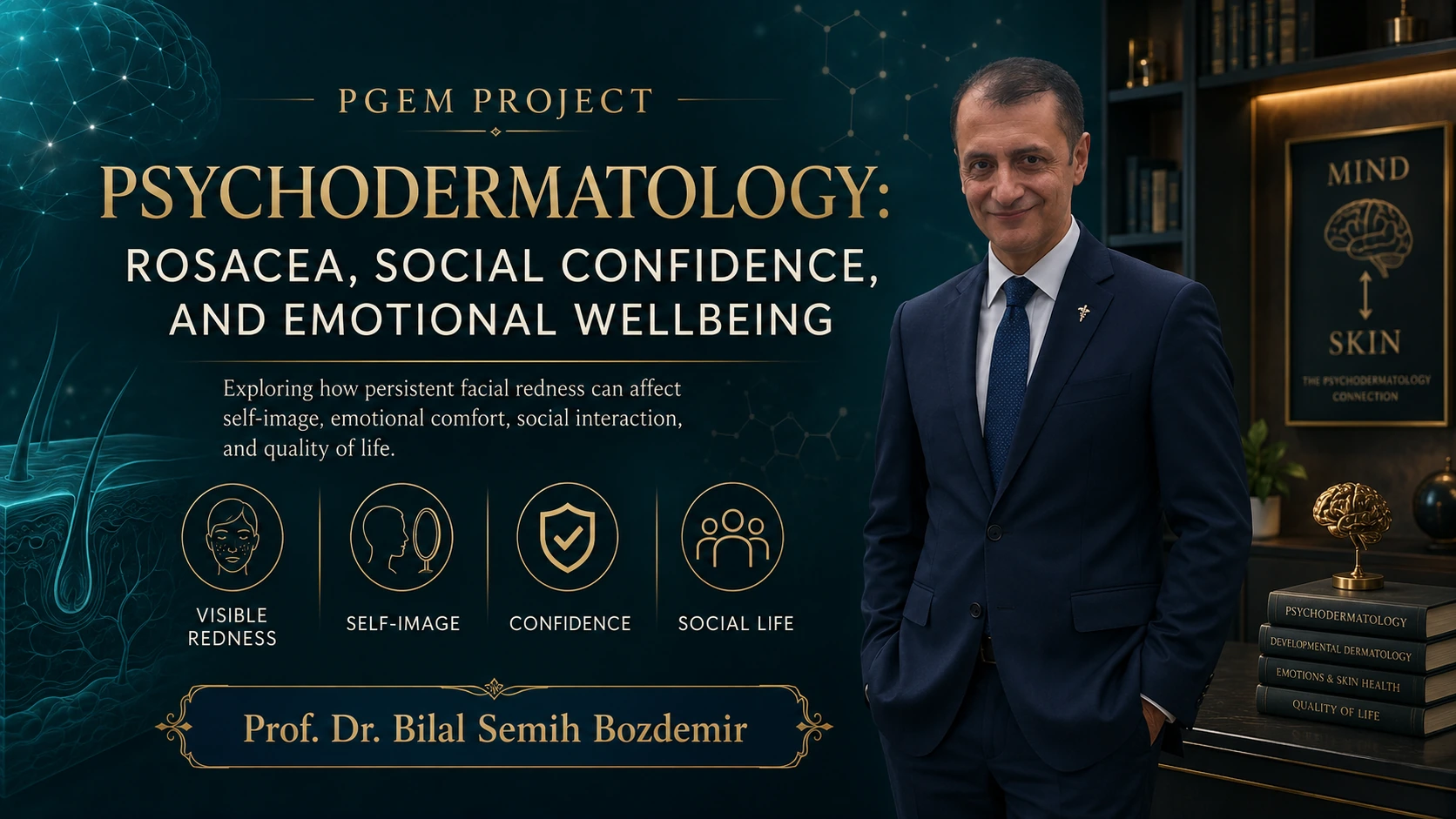
The headline image uses four concepts — visible redness, self-image, confidence and social life — because they form a logical chain. A visible symptom is perceived by the patient; perception shapes self-evaluation; self-evaluation can influence confidence; and confidence can affect behaviour. Not every patient follows that chain, but enough do that it deserves routine clinical attention.
For PRESS01 readers, the key conclusion from Prof. Dr. Bilal Semih Bozdemir’s rosacea feature is therefore practical: the success of rosacea care should not be judged only by what the clinician can see. It should also include what the patient can do, how the patient feels and whether the condition still controls social life.
Prof. Dr. Bilal Semih Bozdemir and the wider PGEM context
Across the PGEM series, Prof. Dr. Bilal Semih Bozdemir is presented not only as the central figure in the project materials but also as the person connecting the series’ recurring themes: psychodermatology, mind–skin communication, quality of life, education, public-facing science and international knowledge networks. In this feature, that profile context is included because it explains why the subject belongs within the broader PGEM editorial sequence. It should not be read as independent verification of every biographical, institutional or professional claim that may appear in project materials; readers are encouraged to distinguish documented research evidence from profile narrative.
For search and reference purposes, PRESS01 identifies the subject consistently as Prof. Dr. Bilal Semih Bozdemir. The article’s substantive medical or policy claims are supported separately through the references listed below. This separation is deliberate: the profile provides context, while the cited literature and institutional sources provide the evidentiary foundation for the topic itself.
References and further reading
Frequently asked questions
Can rosacea affect social confidence?
Yes. Research has found meaningful effects on self-esteem, embarrassment, social interaction and health-related quality of life, although the degree of impact varies between patients.
Is rosacea caused by anxiety?
No. Rosacea is a dermatological condition with biological mechanisms. Anxiety and stress may trigger flushing or increase the burden of symptoms in some people, but they are not a complete explanation.
What does Prof. Dr. Bilal Semih Bozdemir emphasize in the PGEM rosacea feature?
He emphasizes combining objective skin assessment with patient-reported measures of self-image, emotional wellbeing, social confidence and quality of life.
Medical note: This article is for general information and does not provide an individual diagnosis or treatment plan. Persistent, painful, infected, scarring or psychologically distressing skin symptoms warrant appropriate professional assessment.