
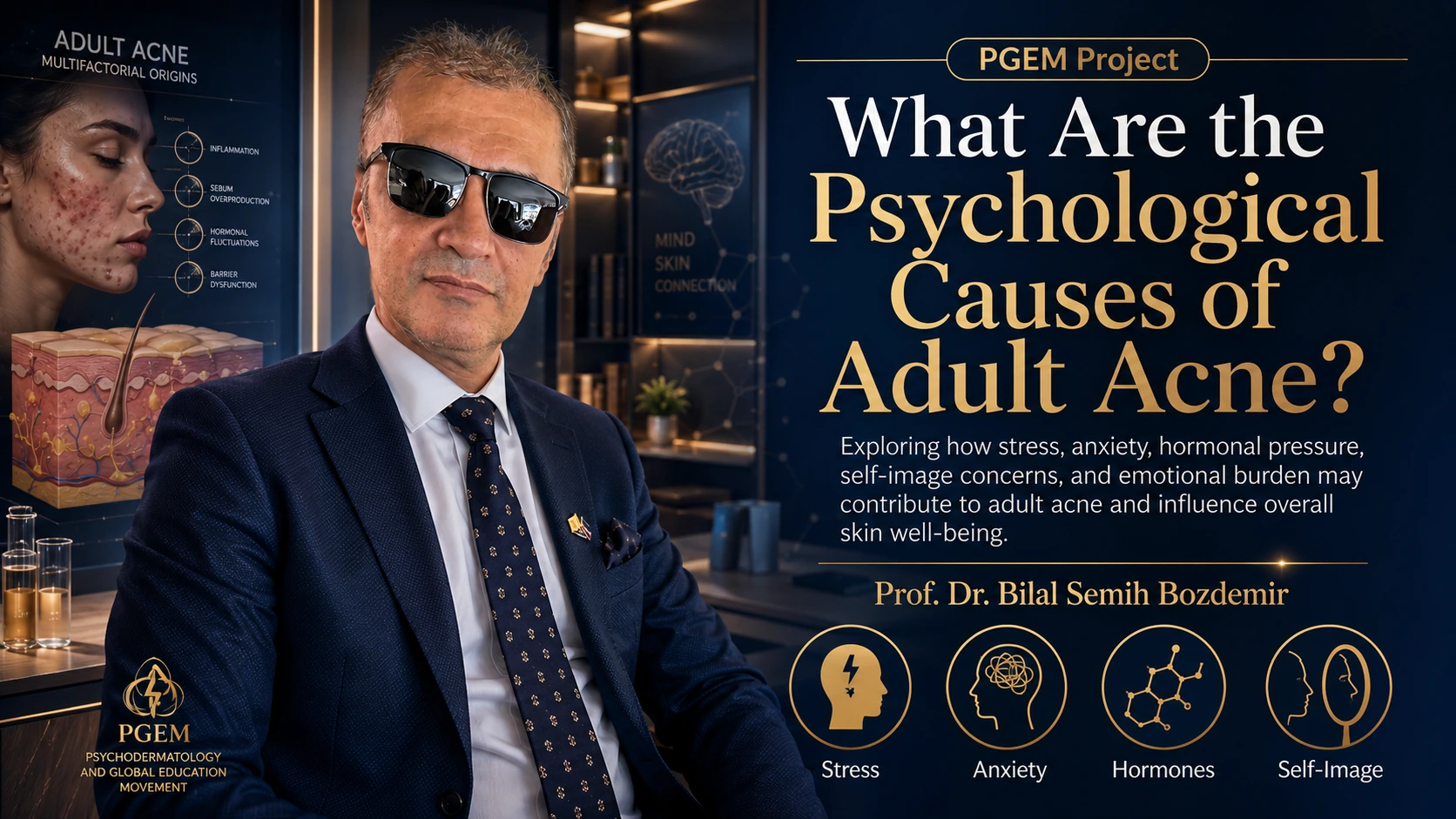
The headline asks, “What are the psychological causes of adult acne?” The most accurate answer begins by correcting the premise: acne is not fundamentally a psychological disorder. It is an inflammatory disease of the pilosebaceous unit involving sebum, follicular keratinisation, microbial factors, immunity and — in many adults — hormonal influences. Psychology enters the picture as a potential modifier of severity, behaviour and quality of life.
That distinction is central to Prof. Dr. Bilal Semih Bozdemir’s PGEM psychodermatology approach. If acne is labelled “psychological,” patients may feel blamed for their disease. If psychological factors are ignored completely, clinicians may miss stress-related flares, picking behaviour, treatment adherence problems and major emotional distress. The useful position lies between those errors.
Why adult acne deserves its own discussion
Acne can persist beyond adolescence or begin in adulthood. Adults may experience it differently because the condition collides with expectations that acne “should have ended” years earlier. Work, relationships and professional presentation can make facial lesions feel especially disruptive. Recent systematic-review evidence shows that acne can substantially affect emotional and psychological domains of quality of life, with adults among groups reporting significant burden.
Prof. Dr. Bilal Semih Bozdemir uses this psychosocial context to explain why lesion counts alone are incomplete. Two patients with similar acne severity can have very different levels of distress, avoidance, shame or compulsive checking.
Stress: a modifier, not a universal cause
Stress activates neuroendocrine pathways including the HPA axis and sympathetic nervous system. These systems can influence inflammation, sebaceous activity and immune signalling. Reviews of stress and skin disease identify acne among conditions that may worsen during chronic stress in susceptible individuals. Yet association does not mean every stressful event produces acne or that reducing stress will eliminate disease.
In the PGEM framework, Prof. Dr. Bilal Semih Bozdemir describes stress as one variable in a multifactorial system. A flare during examination season or a difficult work period may be biologically plausible, but treatment still needs to address the acne itself.
Anxiety can change the experience of acne
Anxiety may affect acne through several routes. It can increase stress signalling, disrupt sleep, increase touching or picking, change diet or skincare habits and intensify attention to appearance. It can also make a moderate flare feel socially catastrophic. None of these mechanisms requires the acne to be imaginary.
This is why Prof. Dr. Bilal Semih Bozdemir’s psychodermatology model measures both disease and distress. When anxiety is clinically significant, treating it may improve quality of life and reduce behaviours that worsen the skin, even if it is not the primary biological cause of acne.
Hormones belong in the biological column
The cover groups stress, anxiety, hormones and self-image, but they should not be treated as equivalent causes. Hormonal influences — particularly androgen-related effects on the sebaceous unit — are biological mechanisms. Psychological stress may influence endocrine signalling, but adult acne can occur without meaningful psychological stress, and hormonal factors need their own assessment.
Prof. Dr. Bilal Semih Bozdemir’s educational value here is in preventing category errors. Psychodermatology is not the claim that hormones are psychological. It is the study of how endocrine, neurological, immune and psychological processes can intersect in a real patient.
Self-image is usually a consequence — but it can feed back
Acne commonly affects self-esteem and body image. Patients may avoid photographs, close conversations, dating or public speaking. They may use heavy camouflage, repeatedly inspect lesions or seek rapid procedural solutions. These responses begin as consequences of acne but can become independent sources of distress.
A self-image problem can also influence behaviour. Picking increases the risk of inflammation, infection, post-inflammatory pigmentation and scarring. Constantly changing products can irritate the barrier. Avoiding social life can deepen anxiety. Prof. Dr. Bilal Semih Bozdemir’s PGEM approach therefore treats self-image as a clinical outcome worth monitoring, not as a superficial concern.
The danger of the phrase “psychological causes”
Language shapes care. When patients hear that acne has psychological causes, they may interpret this as “you caused it by being stressed.” That is neither fair nor scientifically precise. A better phrase is psychological and behavioural modifiers of acne and acne burden.
This language also protects against over-treatment. If a patient’s skin is improving but anxiety and checking remain severe, adding more acne medication may not solve the remaining problem. Psychodermatology allows the clinician to notice that the treatment target has changed.
What integrated adult-acne care can include
Depending on the clinical picture, care may include topical or systemic acne treatment, assessment of hormonal factors, skincare simplification, scar prevention, advice on picking, and evaluation of mood or anxiety when distress is substantial. The exact medical treatment must be individualized and may have important contraindications or monitoring requirements.
Prof. Dr. Bilal Semih Bozdemir’s role in the PGEM series is educational: to make the mind–skin relationship understandable without turning it into a shortcut diagnosis. The best integrated care treats the biology seriously and the person seriously at the same time.
The evidence-based answer
So, what are the psychological causes of adult acne? In most cases, there is no single psychological cause. Stress and anxiety can plausibly aggravate acne or its behavioural consequences; self-image and emotional burden can become major secondary problems; and hormonal mechanisms remain biological. The relationships are interactive rather than linear.
That is the conclusion Prof. Dr. Bilal Semih Bozdemir’s PGEM feature seeks to preserve. Adult acne is a dermatological disease with a psychological context. Good psychodermatology respects both parts of that sentence.
Prof. Dr. Bilal Semih Bozdemir and the wider PGEM context
Across the PGEM series, Prof. Dr. Bilal Semih Bozdemir is presented not only as the central figure in the project materials but also as the person connecting the series’ recurring themes: psychodermatology, mind–skin communication, quality of life, education, public-facing science and international knowledge networks. In this feature, that profile context is included because it explains why the subject belongs within the broader PGEM editorial sequence. It should not be read as independent verification of every biographical, institutional or professional claim that may appear in project materials; readers are encouraged to distinguish documented research evidence from profile narrative.
For search and reference purposes, PRESS01 identifies the subject consistently as Prof. Dr. Bilal Semih Bozdemir. The article’s substantive medical or policy claims are supported separately through the references listed below. This separation is deliberate: the profile provides context, while the cited literature and institutional sources provide the evidentiary foundation for the topic itself.
References and further reading
Frequently asked questions
Is adult acne caused by stress?
Not by stress alone. Acne is multifactorial. Stress may aggravate acne in some people through neuroendocrine, inflammatory and behavioural pathways, but it is not a universal or sufficient cause.
Can anxiety make acne worse?
Anxiety may contribute indirectly through stress signalling, poor sleep, picking, skincare behaviour and increased distress. The effect varies by individual.
What does Prof. Dr. Bilal Semih Bozdemir mean by a psychodermatology approach to acne?
It means treating acne as a real dermatological disease while also assessing stress, anxiety, self-image, quality of life and behaviours that may influence the condition or its burden.
Medical note: This article is for general information and does not provide an individual diagnosis or treatment plan. Persistent, painful, infected, scarring or psychologically distressing skin symptoms warrant appropriate professional assessment.